


As part of Amazon’s aggressive effort to get employees back to the office, the company is going a step further and demanding that some staffers move to a central hub to be with their team. Those who are unwilling or unable to comply are being forced to find work elsewhere, and some are choosing to quit, CNBC has learned.
Several employees spoke to CNBC about the new relocation requirement. An employee in Texas, who was hired in a remote role, said managers assured his team in March that nothing would change despite the return-to-office (RTO) mandate issued the prior month. But in July, the team was informed by management that they’d have to choose between working out of Seattle, New York, Austin, Texas, or Arlington, Virginia, according to internal correspondence.
Under the guidelines, remote workers are expected to have completed their move to a main hub by the first half of 2024, the document states. The employee, who doesn’t live near any of the designated cities, chose to leave Amazon after securing another position, in part due to uncertainty about future job security and the potential of higher living costs associated with the relocation with no guarantee of an increase in salary.
The person asked not to be named to avoid retaliation. CNBC spoke with three other employees in similar situations who all asked to remain anonymous.
Amazon spokesperson Rob Munoz confirmed the relocation policy, and said it affects a small percentage of the company’s workforce. The e-commerce giant said hub locations vary by team, and each team determines which locations are their hub. The company does provide relocation benefits to employees asked to move.
“It’s not a one-size-fits-all approach, so we decided that the best thing to do was to communicate directly with teams and individuals who are affected to ensure they’re getting accurate information that’s relevant to them,” Munoz said in a statement. “If an individual feels like they don’t have the information they need, we encourage them to talk with their HR business partner or their manager.”
The relocation requirement is escalating tensions between Amazon and some of its roughly 350,000 corporate employees over RTO plans after many employees moved away from their in-person office location during the Covid pandemic.
In May, Amazon began requiring that staffers work out of physical offices at least three days a week, shifting from a policy that left it up to individual managers to decide how often team members should be in the office. CEO Andy Jassy has extolled the benefits of in-person work, saying it leads to a stronger company culture and collaboration between employees.
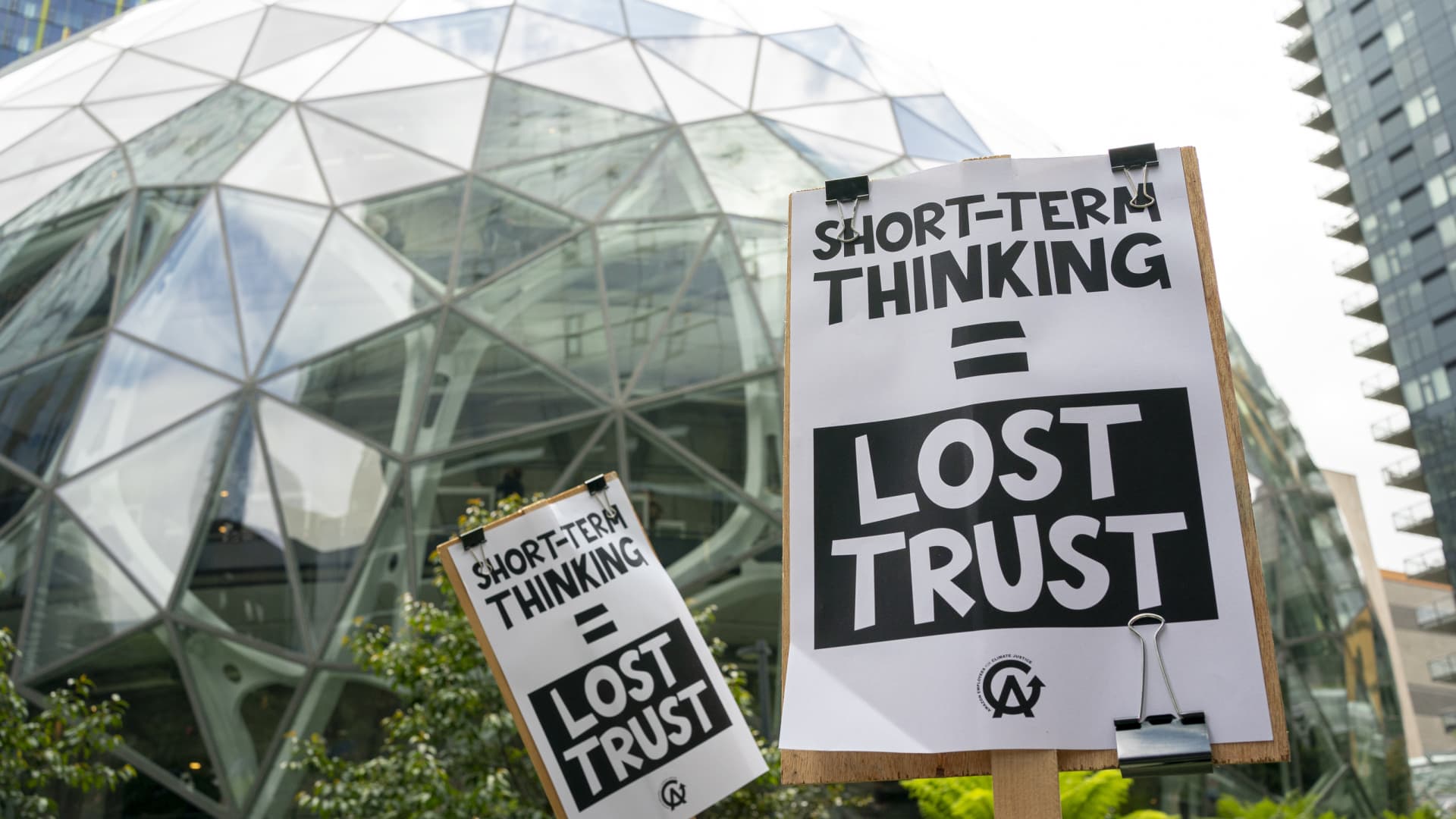
Following the mandate, a group of employees walked out in protest at the company’s Seattle headquarters. Staffers also criticized how Amazon handled the decision to lay off 27,000 people as part of job cuts that began last year.
The company is slashing costs elsewhere as well. Amazon said it will end a perk next year that allows staffers to get one free drink at in-office coffee shops. The company also reduced the amount it reimburses for parking, and stopped providing free Uber rides to and from work, employees said.
Amazon said it still reimburses employees’ public transportation costs in all major metro areas, and provides free commuter shuttles and campus shuttles.
Some employees reprimanded
The return-to-office mandate has been a particularly thorny subject, and enforcement has been a challenge. Amazon sent out a notification earlier this month to some staffers informing them that they weren’t “meeting our expectation of joining your colleagues in the office at least three days a week,” according to a copy of the memo viewed by CNBC. “We expect you to start coming into the office three or more days a week now.”
Some staffers who received that notice had been in compliance with the mandate, while others had taken vacation or sick leave that was approved by their manager, one staffer said. Employees expressed their frustration over the notice in comments on an internal support ticket, said the person, who asked to remain anonymous because he wasn’t authorized to speak on the matter.
Amazon responded to the ticket, explaining internally the notice was sent to employees who it determined had badged in fewer than three days a week for at least five of the past eight weeks or at least three of the past four weeks.
“If you believe that you received this email in error, please reach out to your manager to discuss your situation and ensure it is accurately reflected in the system,” the company said on the support site.
Amazon confirmed the authenticity of the internal correspondence. The company stressed it had called employees back to the office three days a week because it felt it would be beneficial for company culture.
“We knew that there would be some adjustment period, so we’ve worked to support people as they’ve figured out their routines,” Munoz said in a statement. “With three months under our belt, and a lot more people back in the office, we’re reiterating our expectation that people join their teammates at least three days in the office.”
For employees affected by the relocation policy, Amazon is asking that they move to a designated hub, which could be Seattle, Arlington, New York, Chicago, San Francisco or another main office. Some employees see it as a stark reversal from the company’s approach during the pandemic, when Amazon ramped up its recruiting outside of Seattle and Silicon Valley, and pledged to expand its presence in markets like Phoenix, Dallas and San Diego.
The employees who spoke to CNBC said they view the relocation requirement as onerous and significantly disruptive to their personal lives. In some cases, staffers are being asked to move out of state, which would require them to break their housing lease, or transition their children to new schools.
Amazon has informed the employees individually about the change, but the company hasn’t put out any official communication to the broader workforce. In late July, managers began informing employees that they’d soon be expected to work from a main hub location, and they could choose between relocating, finding another job internally or resigning. Some were told they had 30 to 60 days to make a decision, the staffers said.
Three employees based in different locations — Colorado, Utah and California — were each asked to relocate to Seattle. They told CNBC they’ve chosen to leave Amazon because moving would burden them financially or put too much strain on their family.
The employees said the relocation requirement made little sense to them, noting they already live within walking or commuting distance of an Amazon office where they’ve been working the mandated three days a week.
The prospect of transferring to a new role within the company isn’t seen as much of an option. Amazon paused corporate hiring last November as part of wider cost-cutting efforts, which translates into fewer job openings than normal. The staffers told CNBC they weren’t able to find much, if anything, in their current office that’s relevant to their expertise.
Still, it’s a difficult decision to quit, as companies, particularly in the tech industry, have been reducing headcount over the past year to reckon with rising inflation and economic uncertainty.
The crackdown at Amazon is leading to some bending of the rules. In a story last week about some of the RTO changes, Insider reported that some employees have considered using a family member’s address near an Amazon office, or agreed to relocate and then used the time they were given to move to look for another job.
The Colorado-based employee who was asked to move said that, adding it all up, the relocation requirement and Amazon’s broader effort to get people into the office make it feel as if leadership is “trying to make it less enjoyable to work there.”
WATCH: Amazon’s operating margins were three times better than expected
Read the full article here