



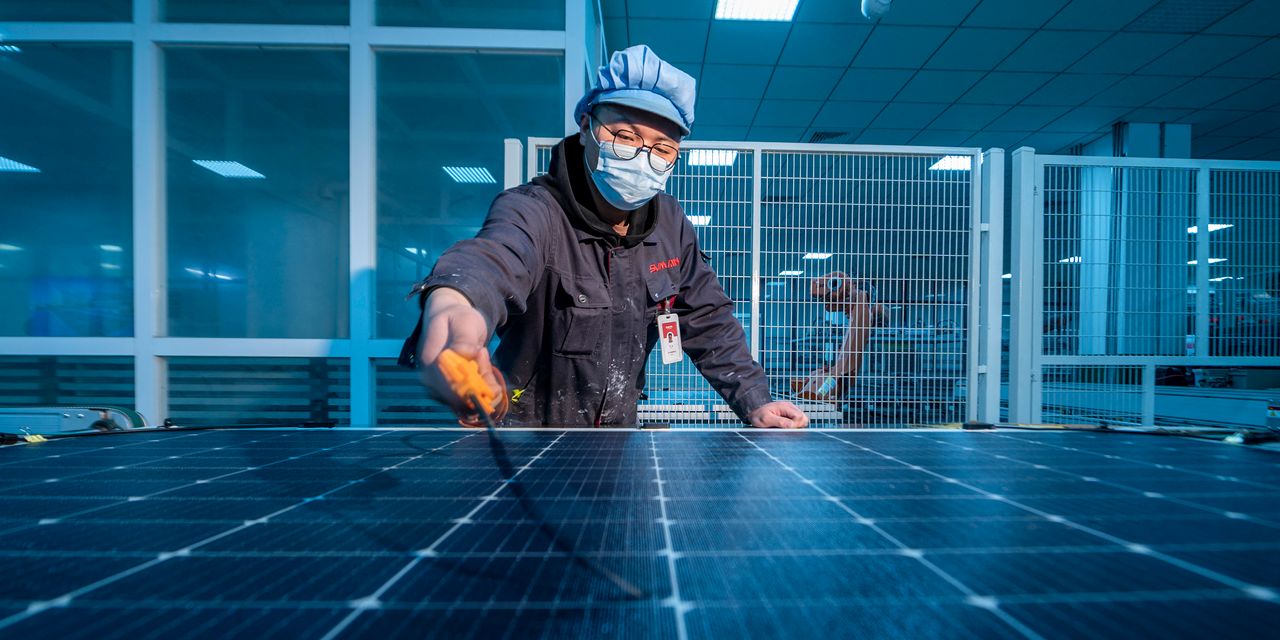
This photo taken on Feb. 20, 2023 shows a worker producing solar photovoltaic modules for export at a factory in Yangzhong, in China’s eastern Jiangsu province.
STR/Getty Images
About the author: Carolyn Kissane is the associate dean of the NYU-School of Professional Studies Center for Global Affairs, and the founding director of the SPS Energy, Climate Justice and Sustainability Lab.
As the world grapples with the urgency of climate change, a different kind of conflict is brewing. This battle will be waged in the realms of technology, economics, and global dominance. Clean-energy innovation has become intertwined with deepening geopolitical tensions as the U.S. takes bold steps to curb China’s military ambitions. The unintended consequences may be to jeopardize the progress needed to address climate change and the required acceleration of the energy transition.
A year ago, the U.S. enacted the Inflation Reduction Act, a monumental piece of legislation that will pour over $370 billion into the climate and clean-energy sectors. This wasn’t just about addressing the need for the U.S. to decarbonize and mitigate against the impacts of climate change. The law was also a strategic maneuver to outcompete and outshine China in the pivotal sectors of the energy transition. The aim: for the U.S. to secure its position as the global clean-energy powerhouse and to address the realities of China’s dominance in critical areas such as minerals, metals, batteries, solar, and increasingly offshore wind technology development and deployment.
But in the time since, the U.S. has taken steps to intensify its efforts to distance itself from China. That includes a move this month by the Biden administration to ban investment in strategic tech sectors: AI, quantum computing, microelectronics, and semiconductors. The deployment of such defensive tools to reduce competition from China marks an important shift. Even in the once hopeful space for cooperation on climate, it’s becoming increasingly evident that unilateralism is now the way forward.
As the U.S. closes doors to tech investments in China, there’s a latent danger of impeding breakthroughs that could benefit climate mitigation. While restricting China, the U.S. could be responsible for inadvertently hampering the technology and tools to accelerate the energy transition.
Hopeful notions of China’s cooperation in climate efforts now seem naïve. The U.S. government’s protective and, from the Chinese side, combative economic tools take precedence over any climate cooperation. These actions hinder prospects for collaborative climate initiatives and erode economic competitiveness in the clean energy space.
To counterbalance China’s military surge and ambitions, the U.S. is reining in and retaining investments in critical technology areas. The government seeks to prevent financial support that could support China’s military modernization and advancements. In 2027, China’s People’s Liberation Army will celebrate its centennial, a moment intended to showcase its accelerated progress in military modernization. This acceleration alarms Washington, driving the U.S. to deter military technology development. The recent announcement of an imminent ban on private equity, venture capital investments that target pivotal technology sectors is just one of the instruments of economic statecraft on steroids.
The consequences of tech-financing bans reverberate far beyond military dynamics. The ban may precipitate short to medium-term setbacks in the clean tech and clean energy sectors. While the focus is on curtailing military threats, the affected areas are also critical in addressing climate change. Quantum simulations and AI advancements could revolutionize battery technology and grid optimization, two cornerstones of the energy transition.
If there’s a silver lining, it’s that urgency is often the catalyst for innovation. This move and the bordering out of investments into China’s tech sectors is forcing U.S. companies to expedite research and development into clean tech innovations using AI and quantum computing.
However, the essence of technological advancement often relies on cross-border collaboration, and these new moves from the U.S. signal blurred the demarcation between prohibited and permitted investment. Many firms may recoil from investment in China’s tech sectors due to mounting policy and regulatory uncertainties.
U.S. private equity and venture capital investments in China are dwindling. As the investment wall gets higher, U.S. firms are effectively moving toward self-sanctioning out of fear of next moves and potential retaliation from China.
The U.S. containment strategy will lead to tit-for-tat retaliation, potentially slowing down decarbonization. China’s dominance in solar and increasingly in offshore wind and its stranglehold on critical minerals and metals could undermine not only U.S. efforts but also Europe’s attempts to keep the costs of the energy transition affordable.
The outcome remains uncertain in this era of great power competition, where politics, economics, and the environment intertwine. Will the U.S. efforts to thwart China’s military prowess lead to an energy-transition slowdown? Will what little was left of climate cooperation rapidly give way to a more combative and even anti-competitive stance in the climate and energy space? Or will the chaos catalyze an era of unparalleled innovation? The quest for national security should not sacrifice nor deter the need for climate and energy security.
Guest commentaries like this one are written by authors outside the Barron’s and MarketWatch newsroom. They reflect the perspective and opinions of the authors. Submit commentary proposals and other feedback to [email protected].
Read the full article here