


• Home
  • News
  • Personal Finance
    • Savings
    • Banking
    • Mortgage
    • Retirement
    • Taxes
    • Wealth
  • Make Money
  • Budgeting
  • Burrow
  • Investing
  • Credit Cards
  • Loans

Subscribe to Updates

Get the latest finance news and updates directly to your inbox.

Top News

30 Things Frugal Pros Never Buy (and What They Do Instead)

January 22, 2026

Degrees Are the Past, Skills Are the Future: How to Win the 2026 Skills-First Job Market

January 22, 2026

Why I Told My Team to Take Walks During Our Biggest Crisis

January 22, 2026
Facebook Twitter Instagram
Trending
  • 30 Things Frugal Pros Never Buy (and What They Do Instead)
  • Degrees Are the Past, Skills Are the Future: How to Win the 2026 Skills-First Job Market
  • Why I Told My Team to Take Walks During Our Biggest Crisis
  • Why Experience Is the Only Education That Matters
  • What You Need to Know About UI/UX Design in 2026
  • How to Turn Ordinary Customers Into Your Most Loyal Advocates
  • The Great Wealth Transfer’s Hidden Housing Problem
  • 8 Foods and Drinks That Are Full of Plastic (How Many Do You Eat?)
Thursday, January 22
Facebook Twitter Instagram
iSafeSpend
Subscribe For Alerts
  • Home
  • News
  • Personal Finance
    • Savings
    • Banking
    • Mortgage
    • Retirement
    • Taxes
    • Wealth
  • Make Money
  • Budgeting
  • Burrow
  • Investing
  • Credit Cards
  • Loans
iSafeSpend
Home » Capitalists Cheer Jobs Report: Evidence For Weakening Labor Power
Retirement

Capitalists Cheer Jobs Report: Evidence For Weakening Labor Power

News RoomBy News RoomSeptember 1, 20230 Views0
Facebook Twitter Pinterest LinkedIn WhatsApp Reddit Email Tumblr Telegram

Stock markets smile when job markets frown.

Except for workers, almost everyone is happy about today’s jobs report. Wealthy owners of equities see stock values rise when workers are hurting; the soft labor market means to investors workers won’t have power to drive up wages and the Fed will slow down interest rate hikes.

Just a year ago, talk was that the tables had turned in the labor capital fight and workers had the upper – hand. “Quiet quitting,” which means “working to the rule;” “not giving your all;” doing just enough not to get fired; not taking the initiative, slow-walking the job was actually a thing and a fear for only a few months (according to Google term search the terms peaked in August 2022 and dropped off by Thanksgiving 2022. Actual productivity trends never validated that particular employers’ fear and workers’ fantasy.

The Wall Street Journal coined “quiet cutting,” a term for a new employer strategy to engage in subtle layoffs. Quiet cutting involves changing employees’ job — often in unpleasant ways — hoping their employees actually quit (saves on severance costs!)

Sluggish Real Earnings Indicates Employers Have The Upper Hand

Only one industry, the lowest-paid leisure and hospitality sector, which pays $560 per week, did not suffer a real wage loss. Workers in high-paid financial services and information technology, on the other hand, has severe real wage losses, far exceeding the average loss in real earnings since the first quarter of 2021 of 6.2 %.

Jack Janasiewicz, Portfolio Manager and Lead Portfolio Strategist at Natixis, in an email sums up the asymmetry between the fate of workers and the stock market. He is honest indicating workers may be unhappy. He writes that the stock market may be rising and will rise because, “wages have been adjusting accordingly albeit at a slower pace than many market participants might like.”

Worker Confidence is Down

Today’s Labor Department report confirms recent data from the U.S. Job Openings Survey (JOLTS) that the labor market is softer, weakening for workers, and becoming more favorable to employers than workers. The most recent JOLTS survey showed U.S. job openings falling to the lowest levels in over two years.

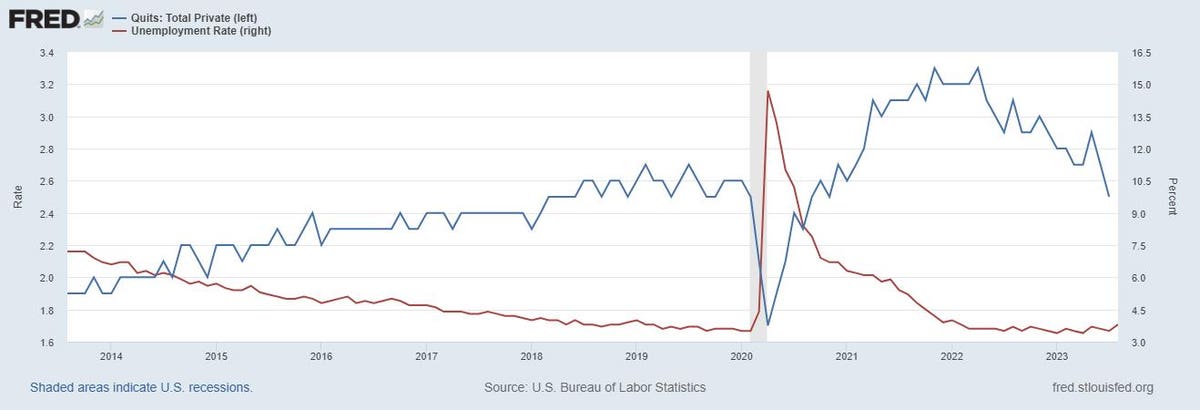
Indicators of worker fears and low confidence show up in the quits rate – which dropped to the lowest level since the start of 2021. The biggest drops in quits is in leisure and hospitality but quits are also lower in the financial activities sector.

The “job leaver rates” are also down to 12.8%. Last month 14.6% of the unemployed were jobless because they quit — they may have walked off the job singing “Take the Job and Shove It.” Fewer were humming that tune in August.

Worker Confidence Show Signs Of Secular Decline

In 1983 a national survey asked workers, “About how easy would it be for you to find a job with another employer with approximately the same income and fringe benefits you now have? Would you say Very Easy, Somewhat Easy, or Not Easy At All?” In 1983, at the end of a deep recession 19% said it would be easy. In the last 40 years that question has been asked from time to time and the answer is loosely correlated with unemployment in the way you would expect (when unemployment increases, worker confidence falls). But something has happened that indicates more worker fear. In 2022, with unemployment at a super low 3.8%; only 11% of workers said it would be easy to find a comparable job. In 1983 with 9.6% unemployment, more workers were confident they could find a job as good as the one they have than they do now.

What is my forecast for the next year? Quiet smugness. We shall see continued signs of labor market softening, weaker wage pressures, slowing inflation, and pleased employers and stock owners.

*****

Quits Rates Once, Understandably, Moved In The Opposite Direction With The Unemployment Rate Until Recently Indicating Lower Worker Power

Read the full article here

Share. Facebook Twitter Pinterest LinkedIn Tumblr Email

Related Articles

The Great Wealth Transfer’s Hidden Housing Problem

Retirement January 21, 2026

The Main Reason Not To Retire

Retirement January 20, 2026

Is It Time For Retirees To Cash In Their Stock Market Gains?

Retirement January 16, 2026

2025 Year-End Financial Checklist for Wealthy Investors

Retirement December 9, 2025

Foundations Of Health And Longevity In Retirement

Retirement December 6, 2025

Trump Accounts vs. Baby Bonds: Who Truly Benefits?

Retirement December 5, 2025
Add A Comment

Leave A Reply Cancel Reply

Demo
Top News

Degrees Are the Past, Skills Are the Future: How to Win the 2026 Skills-First Job Market

January 22, 20260 Views

Why I Told My Team to Take Walks During Our Biggest Crisis

January 22, 20260 Views

Why Experience Is the Only Education That Matters

January 22, 20260 Views

What You Need to Know About UI/UX Design in 2026

January 22, 20260 Views
Don't Miss

How to Turn Ordinary Customers Into Your Most Loyal Advocates

By News RoomJanuary 22, 2026

Entrepreneur Key Takeaways Explores a framework for understanding how customers experience and engage with your…

The Great Wealth Transfer’s Hidden Housing Problem

January 21, 2026

8 Foods and Drinks That Are Full of Plastic (How Many Do You Eat?)

January 21, 2026

Social Security Is Changing How It Handles Your Case — Why Experts Are Worried

January 21, 2026
About Us

Your number 1 source for the latest finance, making money, saving money and budgeting. follow us now to get the news that matters to you.

We're accepting new partnerships right now.

Email Us: [email protected]

Our Picks

30 Things Frugal Pros Never Buy (and What They Do Instead)

January 22, 2026

Degrees Are the Past, Skills Are the Future: How to Win the 2026 Skills-First Job Market

January 22, 2026

Why I Told My Team to Take Walks During Our Biggest Crisis

January 22, 2026
Most Popular

Why Your Website Gets Clicks But No Customers

January 17, 20262 Views

I’m a CPA: 7 Tax Breaks Seniors Forget to Claim

January 16, 20262 Views

The $160K Recovery Chamber Pro Athletes Swear By

January 16, 20262 Views
Facebook Twitter Instagram Pinterest Dribbble
  • Privacy Policy
  • Terms of use
  • Press Release
  • Advertise
  • Contact
© 2026 iSafeSpend. All Rights Reserved.

Type above and press Enter to search. Press Esc to cancel.