



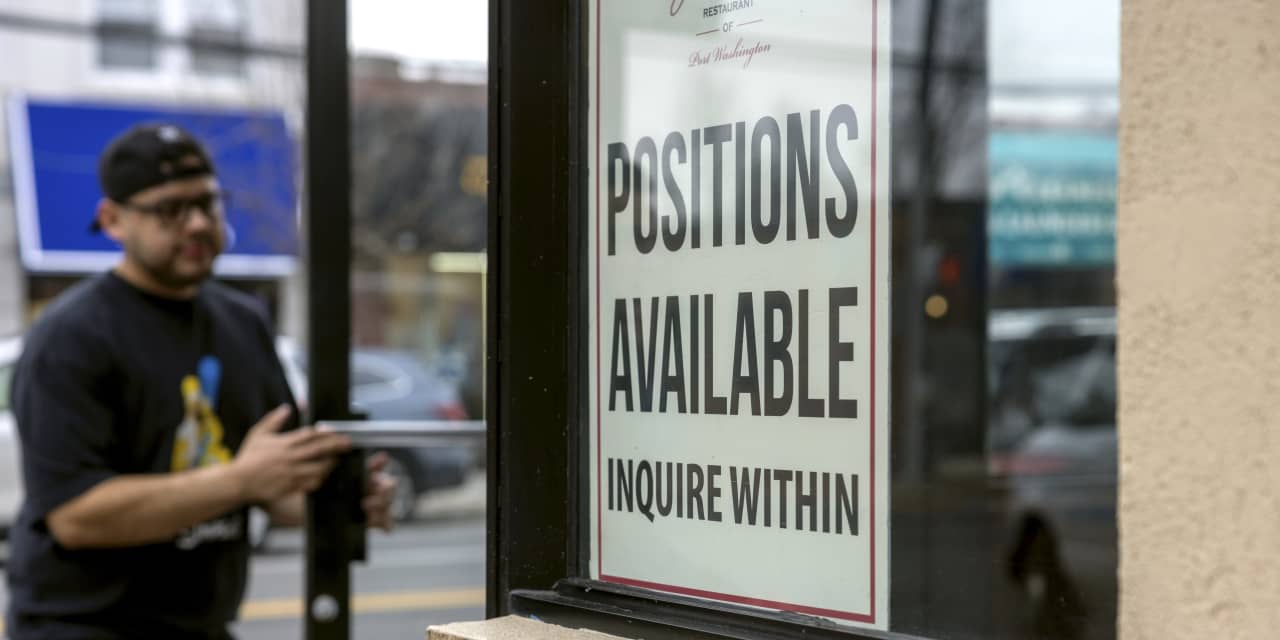
Hopes that the Federal Reserve might be ready to stop raising rates, further fueled by Friday’s release of the August payrolls report, have helped buoy stocks.
Howard Schnapp/Newsday/Getty Images
September is here, and that can mean only one thing—it’s time to give up and go home. Or maybe not.
There’s a lot to like about September. Temperatures are cooling, days are getting shorter but not too short, kids are going back to school, and the leaves are getting ready to turn. For the stock market, though, September is dreadful.
Bad things happen in September, including the tragedy of Sept. 11 in 2001 and the bankruptcy of Lehman Brothers in 2007. September has been negative for stocks for three years in a row, and it was the worst month in a terrible 2022 and an otherwise solid 2021. All told, the
S&P 500
has dropped an average of 1.1% in September since 1928, the only month to average a loss greater than 0.13%. It’s enough to wonder why anyone bothers showing up—unless it’s to place short bets.
But September doesn’t have to be awful—and history suggests that this year’s might be one of the better ones. We’ll throw some numbers your way, in case you don’t want to take our word for it. The last time the S&P 500 had a three-September losing streak—from 2014 through 2016—it followed with a three-year winning streak, suggesting an almost biblical sequence of good following bad.
Even better, when the S&P 500 has posted a gain of 10% to 20% through August, it has averaged a gain of 7.6% for the rest of the year, according to Bank of America data. That suggests the S&P 500 could close the year near 4850, which would be a new high for the index.
We can already hear the protests. This market, after all, has been driven by big gains in just seven large tech stocks—
Alphabet
(ticker: GOOGL),
Amazon.com
(AMZN),
Apple
(AAPL),
Meta Platforms
(META),
Nvidia
(NVDA),
Microsoft
(MSFT), and
Tesla
(TSLA)—and a boom in artificial intelligence that looks a lot like a bubble.
Hopes that the Federal Reserve might be ready to stop raising rates, further fueled by Friday’s release of the August payrolls report, have also buoyed stocks. Yet there’s more to the rally than just some enthusiasm for the next big thing and a misguided hope that monetary policy will return to the halcyon days of Alan Greenspan.
There is something more fundamental going on, and that something is corporate earnings. This past week, the Bureau of Economic Analysis released its second-quarter profit report, which showed profits had declined 0.65% from the same period in 2022. That jibes with what we saw during earnings season, when S&P 500 profits slid 2.9% year over year. Yet, those numbers understate how much earnings have been improving. Corporate profits fell just 0.4% in the second quarter from the first, a sign that the decline may be reaching an end, while profits for nonfinancial companies rose 0.9% quarter over quarter.
Wall Street is predicting that the worst is over. S&P 500 earnings are expected to drop 0.1% during the third quarter and then rise by 9.1% in the fourth, before rising 12% in 2024, and those estimates have only been getting better. One of the big reasons is forecasts for profit margins, according to economist Ed Yardeni.
Expectations for profit margins dropped as low as 12.3% during the week of March 30, but hit 12.6% on Aug. 24, the highest level in seven months. The improvement isn’t limited to just a handful of companies, either: Nearly three-quarters of companies in the S&P 500 have seen increases in forward earnings estimates during the past three months, up from 44% near the end of 2022. “I believe that the earnings recession ended in Q2,” Yardeni writes, referring to the two consecutive quarters of earnings declines.
He isn’t the only one. Savita Subramanian, head of U.S. equity and quantitative strategy at Bank of America, also sees more market upside through the remainder of the year, given that economic data remain strong, there’s little risk of downward revisions to 2023 earnings estimates, and an analysis of earnings calls suggests that sentiment has gotten much better over the past 12 months. “Absent a collapse in demand, 2Q likely marks the trough in earnings,” she writes. “[That] argues for risk-on, not risk-off.”
Not everyone buys it. Société Générale’s Albert Edwards, long a bear, argues that large U.S. companies are likely playing the yield curve by borrowing money long term to then earn 5% or more on their cash. As a result, higher rates have added 5% to profits over the past year rather than subtracting 10% or more, as they would usually do when the Fed hikes rates. “Hence, it’s not just ‘greedflation’ that has boosted U.S. profit margins and delayed the recession,” he writes. “Interest rates simply aren’t working as they once did.”
Or maybe they are just working at a slower pace. The labor market, after all, continues to cool, with August’s big jump in the unemployment rate—from 3.5% to 3.8%, its highest since February 2022—suggesting that the excesses of the pandemic era are slowly being unwound. If that slowdown continues, the long-delayed recession might finally arrive.
That’s a problem for 2024. Right now, I’m going to sit back and enjoy this September.
Write to Ben Levisohn at [email protected]
Read the full article here