



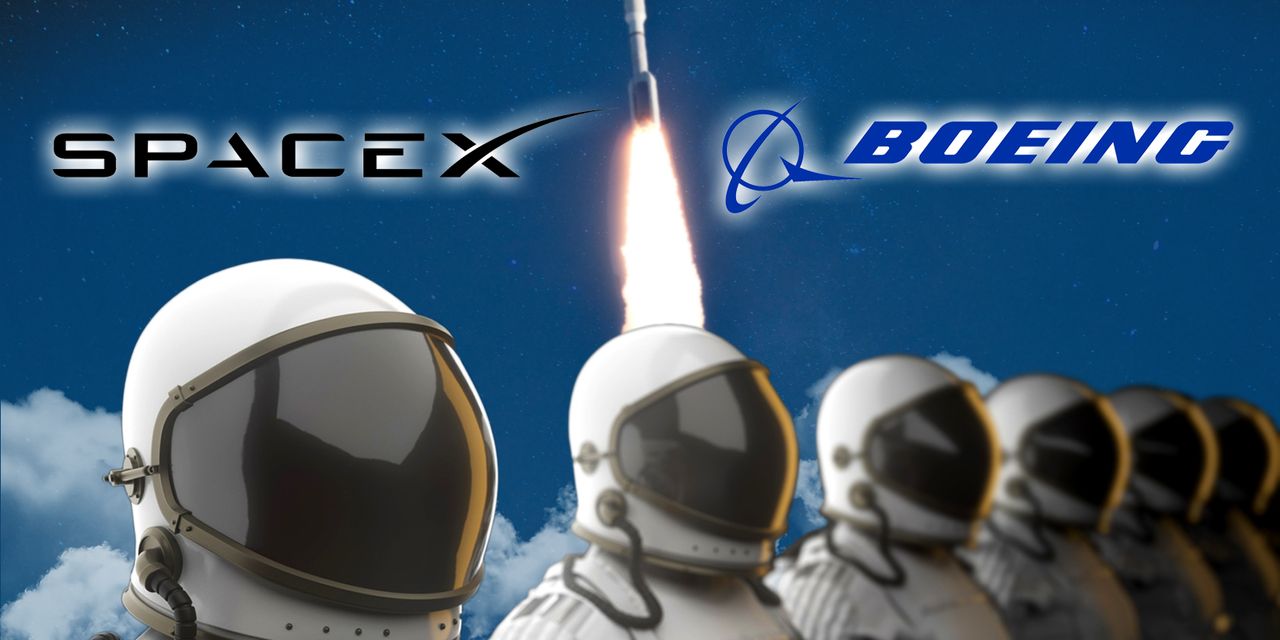
Like never before, the race to the stars has reached fever pitch in the aerospace industry. The past decade brought a seismic shift in the competitive landscape historically dominated by government agencies and long-established corporations. Private-sector companies, driven by innovation and a vision of commercial space travel, have redefined the boundaries of what’s possible.
At the forefront of the revolution are two names that have become synonymous with space exploration: SpaceX and Boeing.
A stalwart of the aerospace industry, Boeing
BA,
has been NASA’s trusted partner for decades. With a legacy that spans decades, since the golden age of aviation to the space shuttle program, the company’s contributions to space exploration are unparalleled. Its expertise and long-standing relationship with NASA positioned it as a natural choice when the agency sought private partnerships for its ambitious Commercial Crew Program in 2010.
The program aimed to foster collaboration with the private sector to develop cost-effective, innovative, and safe methods of transporting astronauts to the International Space Station (ISS). In the end, both Boeing and SpaceX were awarded contracts, setting the stage for a fierce competition. For almost a decade now, the two companies have been in a neck-and-neck race, striving to achieve a coveted goal of launching NASA astronauts from U.S. soil.
The two companies’ trajectories have since diverged. With its relentless drive for innovation and cost-efficiency, SpaceX achieved a monumental milestone in May 2020 by successfully launching NASA astronauts from the U.S. to the ISS, the first time since 2011. It wasn’t just a technical achievement, but also a testament to SpaceX’s ability to deliver on its promises, showcasing its adaptability, speed, and innovative culture.
The company’s commitment to reliability was further underscored when it surpassed the United Launch Alliance (ULA), a joint venture between Boeing and Lockheed Martin
LMT,
Having a longer streak of successful launches than ULA, SpaceX demonstrated that it could consistently deliver on its promises, further widening the gap between itself and Boeing.
“ For Boeing, each misstep has been a public relations nightmare. ”
In contrast, Boeing’s Starliner, once hailed as a promising competitor to SpaceX’s Crew Dragon, has been mired in setbacks and delays. Back in June 2023, Boeing made a disheartening announcement that the crewed launch of its multi-billion-dollar Starliner faced yet another postponement. This time, the culprit was a fresh batch of hardware issues.
The implications of these delays are significant. As of now, Starliner won’t see a launch until March 2024 at the earliest, prompting NASA, which has invested a considerable sum into the yet-to-be-realized crewed craft, to initiate a separate investigation into its failures. The current issues plaguing Boeing’s spacecraft range from parachutes’ “soft link” joints system to the discovery of flammable tape lining the craft’s interior, as reported by Space.com. Adding to Boeing’s woes, the company now finds itself under the scrutiny of three distinct NASA inquiries, all converging on a hopeful 2024 test.
Financially, the repercussions have been severe. Boeing has reported a staggering loss of $1.14 billion on the Starliner project. Given the monumental costs associated with the spacecraft, each misstep has been a public relations nightmare, leaving both the company and NASA grappling with the fallout.
“ One of the most compelling advantages SpaceX brings to the table is its relentless pursuit of cost-efficiency. ”
Meanwhile, SpaceX is on an upward trajectory. The company, founded by Tesla
TSLA,
CEO Elon Musk, recently launched its seventh crewed flight for NASA to the ISS. The disparities between the two companies’ achievements have led many to speculate that NASA might have a clear favorite.
It’s no wonder, really. One of the most compelling advantages SpaceX brings to the table is its relentless pursuit of cost-efficiency. Elon Musk’s vision for SpaceX was not just reaching the stars but doing so in a manner that would drastically reduce the costs associated with space travel.
This vision is epitomized by the company’s development of reusable rocket technology. Falcon 9’s first stage can be recovered and reused multiple times, a feat that was once thought to be the stuff of science fiction. This innovation alone has the potential to reduce the costs of space launches by a significant amount.
SpaceX’s cost-saving measures don’t stop at reusable rockets. The company’s in-house manufacturing approach, where the majority of its rocket parts are produced internally rather than through contractors, drives costs further down. The streamlined approach not only ensures quality control but also reduces the overheads associated with third-party manufacturers.
Said cost innovations have profound implications for future contracts, especially in an era where budget constraints are a significant concern for space agencies and other potential clients. For instance, NASA has a vested interest in ensuring that taxpayer dollars are used efficiently. With SpaceX able to offer reliable launches at a fraction of the cost of traditional providers, it’s no surprise the company increasingly is preferred for a variety of missions.
On the other hand, Boeing, with its traditional manufacturing and operational approach, finds it challenging to compete with SpaceX in terms of cost. The delays and setbacks associated with the Starliner only exacerbate this issue.
Future stars
As the aerospace industry evolves, the importance of cost-effective solutions cannot be overstated. The Commercial Crew Program was just the beginning. With plans for lunar bases, Mars missions, and a growing interest in commercial space travel, the demand for reliable and cost-effective launch providers will only increase.
With its innovative approach and proven track record, SpaceX is well-positioned to dominate a new era of space exploration. Its successful Crew Dragon missions and the ambitious Starlink project demonstrate that the company is not only ahead of the curve but also continually pushing the boundaries of what’s possible.
Despite its rich history, Boeing needs to adapt to this changing landscape. The challenges faced by the Starliner are a wake-up call. To remain competitive, Boeing will need to innovate, streamline its operations, and most importantly, deliver on its promises. The race to the stars is not just about technological prowess but also about vision, adaptability, and cost-efficiency. As SpaceX and Boeing chart their paths forward, the choices they make today will shape the future of space exploration for decades to come.
Read the full article here