


• Home
  • News
  • Personal Finance
    • Savings
    • Banking
    • Mortgage
    • Retirement
    • Taxes
    • Wealth
  • Make Money
  • Budgeting
  • Burrow
  • Investing
  • Credit Cards
  • Loans

Subscribe to Updates

Get the latest finance news and updates directly to your inbox.

Top News

Which Warehouse Membership Actually Pays for Itself — Costco, Sam’s Club or BJ’s?

February 5, 2026

The “Stealth Tax” That’s Quietly Saving Social Security (and Costing You Thousands)

February 5, 2026

How This Founder Made Dry January a Yearly Movement

February 5, 2026
Facebook Twitter Instagram
Trending
  • Which Warehouse Membership Actually Pays for Itself — Costco, Sam’s Club or BJ’s?
  • The “Stealth Tax” That’s Quietly Saving Social Security (and Costing You Thousands)
  • How This Founder Made Dry January a Yearly Movement
  • Why AI Is Forcing a Rethink of Business Metrics
  • Why Great Leaders Build Other People’s Legacies First — And How It Strengthens Your Own Impact
  • AI’s Causing a Leadership Crisis. This Is Your Wake-Up Call.
  • Are Blue States Really Paying More for Electricity Than Red States? Here’s What the Data Says.
  • As a CPA, I Thought I Knew Social Security — Until I Retired. Here Are 5 Costly Blunders Even the Experts Make.
Thursday, February 5
Facebook Twitter Instagram
iSafeSpend
Subscribe For Alerts
  • Home
  • News
  • Personal Finance
    • Savings
    • Banking
    • Mortgage
    • Retirement
    • Taxes
    • Wealth
  • Make Money
  • Budgeting
  • Burrow
  • Investing
  • Credit Cards
  • Loans
iSafeSpend
Home » Too Few Executives Understand The Necessary Balance With Labor
Personal Finance

Too Few Executives Understand The Necessary Balance With Labor

News RoomBy News RoomSeptember 26, 20230 Views0
Facebook Twitter Pinterest LinkedIn WhatsApp Reddit Email Tumblr Telegram

There is a reasonable chance that you’ve at least heard of Australian real estate developer Tim Gurner. He is the millionaire employer who declared that “there’s been a systematic change where employees feel the employer is extremely lucky to have them as opposed to the other way around,” and that unemployment needed to rise by 40% or 50%, there needed to be pain in the economy and that “we need to remind people that they work for the employer, not the other way around.”

Gurner eventually apologized, according to Sky News. Gurner’s apology said, “My comments were deeply insensitive to employees, tradies [trade workers in construction], and families across Australia who are affected by these cost-of-living pressures and job losses.”

What else was he going to say at that point?

It isn’t often you hear an executive publicly say something so brazen and entitled. But this attitude is far from new. In the 1990s, I was sitting with a group of executives who had been in a board meeting. One of them that I knew mentioned something he had read by Earl Nightingale, that workers should understand they were lucky to have a job.

I’ve never read anything by Nightingale but understand that he grew up during the Great Depression, with a father that left the family, meaning that Nightingale, his brother, and his mother had to live in federal housing. He knew what it was like for people who couldn’t find jobs, no matter how hard they tried.

Having a job for millions was and is important and a stroke of luck. Perhaps that is part of what Nightingale meant. Or maybe not.

But the person quoting Nightingale, someone who had grown up in relative economic luxury, was repeating this story and in the way that Gurner intended. Employees should regard the employer as a benefactor who was owed fealty and diligent effort to do anything the company required.

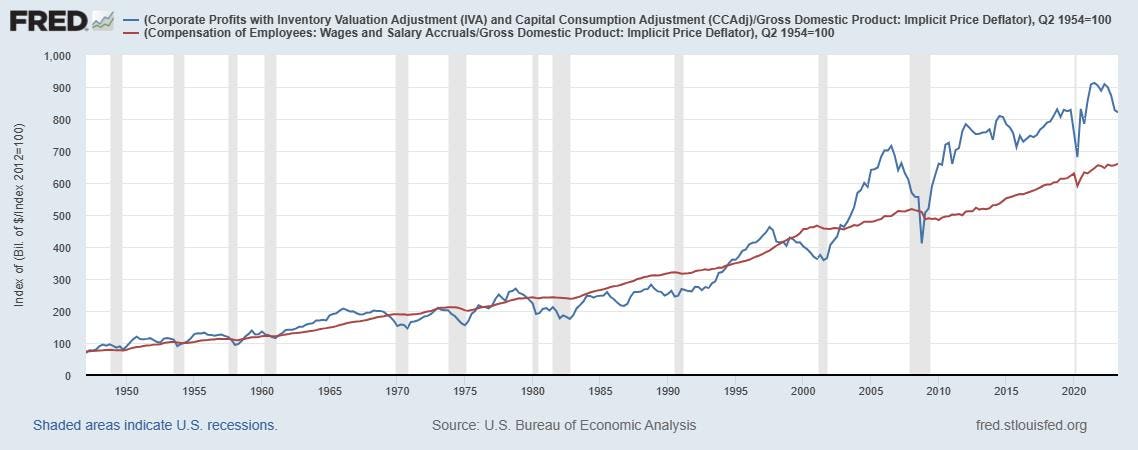
Such a one-sided view gets to the heart of why the strikes in Hollywood have gone on so long (even assuming that the Writers Guild members will vote in favor of the new negotiated contract). A look at employee compensation and corporate profits helps explain how things have moved out of an historical balance.

Anyone who says that worker entitle are off in an historical context have the picture upside down. It is the employers whose expectations have skyrocketed, who have taken more while delivering less.

The Screen Actors Guild has pushed back hard against studio demands that they should be able to digitally capture images of many performers and then use them with ratification intelligence animation as puppets. The studios want to own the essence of performance for one-time payment. To own the future work someone could provide without additional compensation. To drain them of future potential earnings.

Historically, employees didn’t push for outrageous compensation. It grew over time as did inflation. Companies also kept roughly along a line though with a lot more volatility, following the ups and downs of business cycles, making more when times were good, making less during recessions. However, over time, corporate profits took over, soaking up a greater percentage of revenue and reducing the possible compensation of workers because more was pocketed by shareholders and executives.

The old equilibrium is gone, which is why there is so much strike activity these days. Employees are demanding a right-sizing of the relationship and a return of the traditional balance. People who need jobs are fortunate that there are companies to provide them; however, companies really are fortunate that people will work for them. Pushing too far on either side upsets everything and creates situations like that of trucking company Yellow Corp. The workers were willing to lose their jobs because they felt there was nothing left.

Read the full article here

Share. Facebook Twitter Pinterest LinkedIn Tumblr Email

Related Articles

How A 529 Plan Can Help A Child Save For Retirement

Retirement January 30, 2026

5 Resources For Long Life Learning

Retirement January 29, 2026

Pre-Tax IRA To 401(k) Transfers

Retirement January 28, 2026

IRS Gives IRA Providers More Time To Implement SECURE 2.0 Changes

Retirement January 27, 2026

Winter Savings Very Few People Use, But Everyone Qualifies For

Savings January 26, 2026

The Great Wealth Transfer’s Hidden Housing Problem

Retirement January 21, 2026
Add A Comment

Leave A Reply Cancel Reply

Demo
Top News

The “Stealth Tax” That’s Quietly Saving Social Security (and Costing You Thousands)

February 5, 20260 Views

How This Founder Made Dry January a Yearly Movement

February 5, 20260 Views

Why AI Is Forcing a Rethink of Business Metrics

February 5, 20260 Views

Why Great Leaders Build Other People’s Legacies First — And How It Strengthens Your Own Impact

February 5, 20260 Views
Don't Miss

AI’s Causing a Leadership Crisis. This Is Your Wake-Up Call.

By News RoomFebruary 5, 2026

Entrepreneur Key Takeaways As AI becomes embedded across daily workflows, a new challenge is emerging…

Are Blue States Really Paying More for Electricity Than Red States? Here’s What the Data Says.

February 4, 2026

As a CPA, I Thought I Knew Social Security — Until I Retired. Here Are 5 Costly Blunders Even the Experts Make.

February 4, 2026

Revenue Growth Means Nothing If You Ignore This Key Metric

February 4, 2026
About Us

Your number 1 source for the latest finance, making money, saving money and budgeting. follow us now to get the news that matters to you.

We're accepting new partnerships right now.

Email Us: [email protected]

Our Picks

Which Warehouse Membership Actually Pays for Itself — Costco, Sam’s Club or BJ’s?

February 5, 2026

The “Stealth Tax” That’s Quietly Saving Social Security (and Costing You Thousands)

February 5, 2026

How This Founder Made Dry January a Yearly Movement

February 5, 2026
Most Popular

Foundations Of Health And Longevity In Retirement

December 6, 20257 Views

America Has a New Favorite Mattress Brand — but There’s a Hitch to Maximizing Your Satisfaction

December 6, 20253 Views

Feeling Stuck in the Weeds? Here’s How to Break Free.

February 3, 20262 Views
Facebook Twitter Instagram Pinterest Dribbble
  • Privacy Policy
  • Terms of use
  • Press Release
  • Advertise
  • Contact
© 2026 iSafeSpend. All Rights Reserved.

Type above and press Enter to search. Press Esc to cancel.