


That cracking sound in financial markets isn’t the typical kind of break, where one asset class or another fractures and gives way. Instead, this is more a break in a narrative, one that has widespread repercussions.
The narrative in question is the one where the Federal Reserve holds interest rates low and everyone on Wall Street gets to enjoy the fruits.
That’s changing.
In its place comes a story in which rates are going to stay higher for longer, an idea Fed officials have tried to get the market to accept and which investors are only now beginning to absorb.
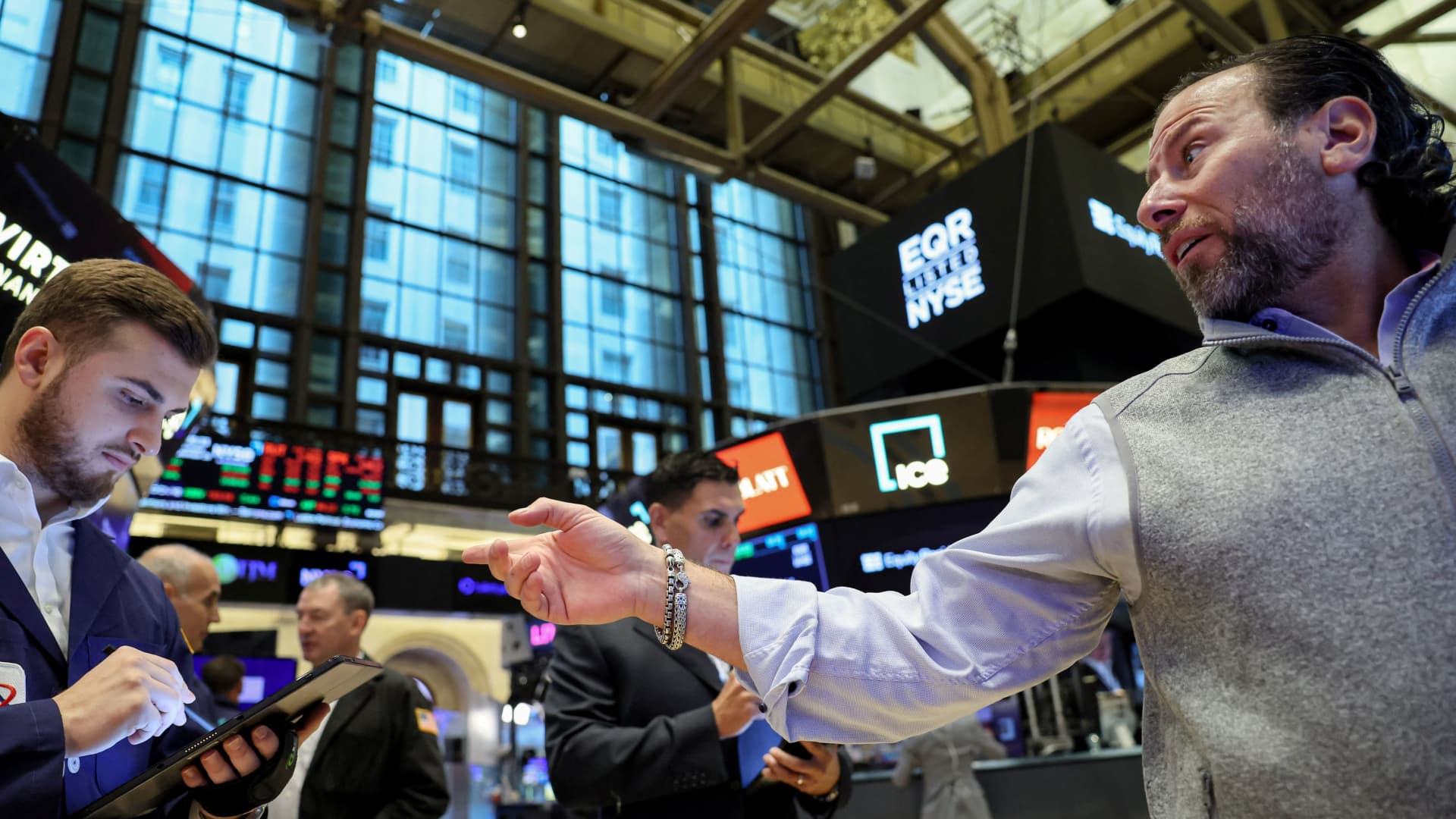
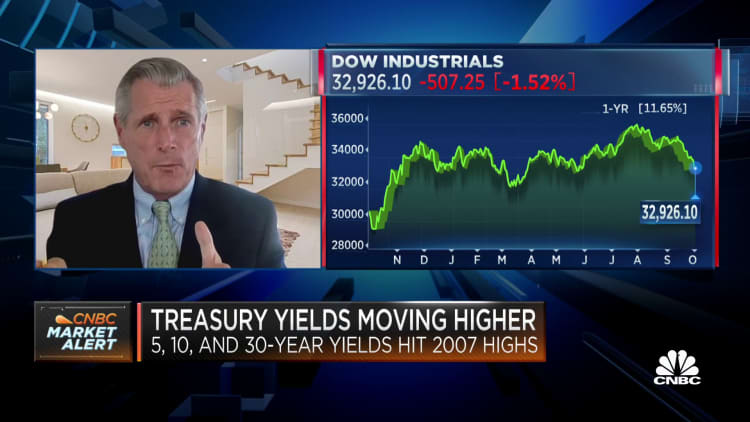
The pain of recognition was acute for Wall Street on Tuesday, with major averages down sharply across the board and Treasury yields surging to their highest levels in some 16 years.
“When you have an economy predicated on zero rates, this fast move [by the 10-year Treasury yield] towards 5%, the calculus has to change, because the ramifications are going to change,” said Quincy Krosby, chief global strategist at LPL Financial. “The cost of capital is going up, companies are going to have to refinance at a higher rate.”
The surge in rates is especially ominous as corporate America heads to third-quarter earnings reporting season, which is right around the corner.
“All of this has to be assimilated and digested by the market,” Krosby added. “You can see that it’s troubling and it’s difficult.”
Economic and inflation concerns
There were signs early Tuesday that it could be another tough day for a market just coming off a brutal September.
But the carnage really got going following the 10 a.m. ET release of a Labor Department report showing that job openings took a sudden swing higher in August, countering the prevailing wisdom that the employment picture was loosening and thus putting less upward pressure on wages.
In turn, traders grew worried that the Fed would be forced to keep monetary policy tight. That sentiment was buttressed this week, when at least four central bank officials either endorsed hikes or indicated that higher rates would be staying in place for an extended period.
Along with the slide in stocks, the yield on 10- and 30-year government debt instruments hit highs last seen as the economy was moving towards the financial crisis.
Bond yields
“So much of the economy has evolved because of low rates and negative rates,” Krosby said. “Now it’s adjusting to what would be considered a historically more normal rate regime.”
Getting used to a more typical rate structure doesn’t sound like such a terrible thing. After all, prior to the financial crisis, the 10-year Treasury yield had averaged around 7%, though that also was skewed by the historic rate increases in the early 1980s.
But after 15 years of living in an unnaturally low rate regime, normal sounds, well, abnormal.
Trouble for financials
Multiple parts of the economy face substantial interest rate risk, but none more so than banks. The sector was jolted earlier this year by the high-profile failure of a few banks that had built up too much long-duration government debt, then had to sell at a loss following deposit runs.
In the second quarter, unrealized losses on bank balance sheets totaled $558.4 billion, an 8.3% jump from the prior period, according to the FDIC. Of that total, held-to-maturity Treasurys, which caused much of the turmoil this year, totaled $309.6 billion.
That number is expected to climb, said Wall Street veteran Larry McDonald, founder of The Bear Traps Report.
“The problem is, when your core capital is weak, any weakness on the other side is exponentially worse,” he said. “But if Treasurys go up to 6, 7 [percent on yields], then the leverage goes up exponentially, right? That’s your core capital. That’s the money when you go to the casino you have to put up at the table.”
Should banks have to cover their losses, they may be forced to issue equity, McDonald said. That, in turn, would be dilutive to share price, a situation that likely factored into a loss Tuesday of more than 2% in bank stocks as measured by the SPDR S&P Bank ETF.
There are other ramifications as well.
Consumers, for one, are feeling the squeeze of higher rates on everything from mortgages to credit cards to personal loans. More than 36% of banks reported tightening lending standards in the third quarter, a level that in the past has been consistent with recessions.
At the same time, Washington dysfunction has bond buyers worried about the U.S. fiscal house, with public debt at nearly 120% of GDP and net financing costs running, according to the Congressional Budget Office, toward $745 billion in 2024 after totaling $663 billion this year. Foreign buyers have been stepping away from U.S. government bonds, with China’s holdings down about 17%, or $175 billion, over the past year, according to the Treasury Department.
The Fed itself has been stepping away from the bond market, reducing its Treasury holdings by more than $800 billion since it stopped reinvesting the proceeds from maturing securities in June 2022.
Potential peak for rates
For some in the market, it’s all about to come to a head soon. Rapid moves in market instruments — like this run in yields right now — have in the past sometimes caused problems at hedge funds caught on the other side of the trade.
And there’s this realization that unless something changes quickly, a recession is all but inevitable.
“They can’t hike another basis point,” McDonald said of the Fed. “It’s just too much pain. This type of action is bringing out the pain, and the Fed is now more aware of the bodies that are buried.”
Indeed, former White House economist Joseph LaVorgna thinks the rise in yields is probably pretty close to being over. Potential fallout includes a recession and the Fed having to go back to buying bonds.
“The selling is not explained by fundamental factors,” said LaVorgna, who was chief economist for the National Economic Council under former President Donald Trump and is now holds the same title at SMBC Nikko Securities. “Now, at some point, my guess is that markets will eventually get to cheap enough levels where you’ll bring buyers in. Given the fact that we’re multiple standard deviations away from where rates should be suggests to me that we’re closer to that point.”
A weak labor market or some other signs of cracks in the economy could dissuade the Fed from further hikes and set the stage for lower rates.
“The patient, meaning the financial markets, is not particularly healthy,” LaVorgna said. “The Fed, as I’ve argued many times, for maybe too long a time, has moved too far, too fast. They’ll eventually reverse.”
Read the full article here