


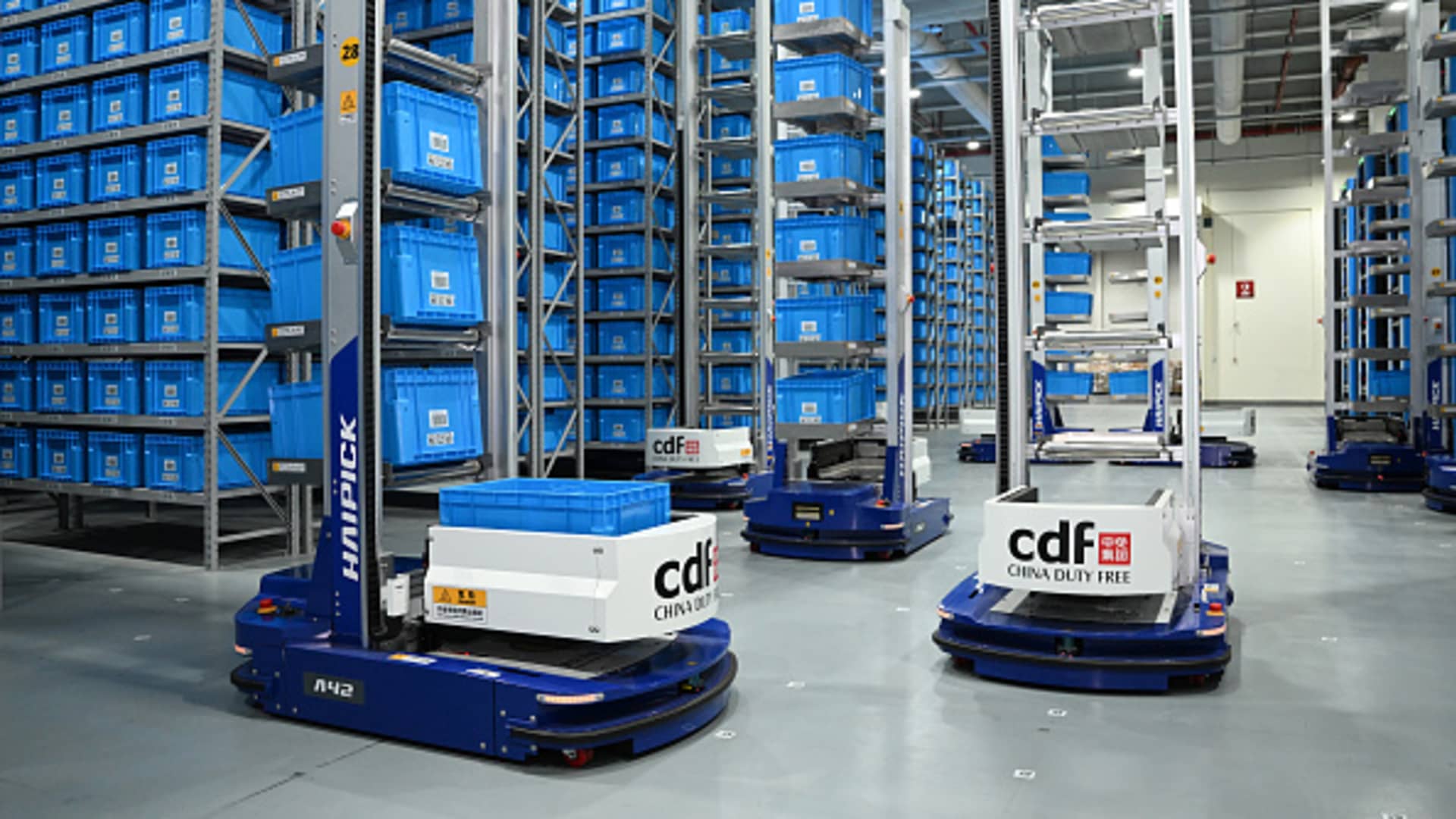
BEIJING — Asia’s competitive advantage was once cheap labor. Now, whether it’s China, India or Japan, the region’s edge lies in industrial services, KKR’s heads of global and Asia macro said in an October note.
That includes logistics, waste management and data centers, the private equity giant said. “We think that there is both internal demand and an external component to this story.”
That investment conclusion comes after a recent trip to Singapore, China and Japan by New York-based Henry H. McVey, chief investment officer of KKR Balance Sheet. He is also KKR’s head of global macro and asset allocation. Singapore-based Frances Lim, managing director and head of Asia macro and asset allocation, also made the trip.
“The bid for infrastructure and logistics could accelerate even more meaningfully, we believe, in key markets such as India, China, Indonesia, the Philippines, Vietnam and even Japan,” the KKR report said.
About 20% of KKR’s balance sheet is allocated to Asia, a region that’s undergoing a longer-term shift requiring more fixed investment, the report said.
While the firm doesn’t break out allocations by country, some of its biggest announced deals in the last two years have been in Japan. That includes a $2 billion acquisition of a Mitsubishi-backed real estate manager in spring 2022.
“I think there are two big megathemes in Japan,” KKR’s McVey said in an interview Thursday. “One is this automation and industrialization, there’s a true capex cycle that’s going on in Japan that we haven’t seen in some time.”
He pointed to Japanese Prime Minister Fumio Kishida’s speech in New York last month, which noted domestic investment is set to break records with more than 100 trillion yen ($673.58 billion) this year.
“If that creates productivity, it’s going to allow them to drive wage increases which is something we haven’t had for some time,” McVey said. He expects Japan is exiting deflation.
The other big trend in Japan, McVey said, is corporate reform that’s boosting shareholder returns.
After decades of sluggish growth, Japan has become a hot spot for international investors this year, against a backdrop of uncertainty about China. In April, U.S. billionaire Warren Buffett visited Japan to announce additional investments into major Japanese companies.
KKR in March said it completed its acquisition of Hitachi Transport System, a logistics company primarily for supply chains, now renamed Logisteed. KKR this year also said it made its first hotel investment in Japan by acquiring Hyatt Regency Tokyo, as part of a deal with Gaw Capital Partners.
“Japan remains a ‘must own’ country, we believe,” the KKR note said, adding that “Japan is a great story that is not trading at a full price.”
As one of the world’s largest private equity firms, KKR said it had $519 billion in assets under management as of June 30.
India
While McVey and Lim didn’t visit India on their latest trip, they said in their co-authored report their time with corporate executives confirmed a positive investment case.
Public capital expenditure in India has grown 200% over four years, while the country’s exports are surging, the report pointed out.
“There’s really finally some investment in infrastructure and that’s leading to, one, greater productivity, but two, it’s helping on the inflation front and it’s helping on the economic growth,” McVey said. He noted that in emerging markets, opportunities to benefit from rising GDP per capita trends are often more accessible in private rather than capital markets.
On Wednesday, KKR announced it opened a new office, in Gurugram, where it has appointed Nisha Awasthi, formerly of BlackRock, as managing director and anticipates 150 new employees by early 2024.
That expansion to northern India adds to an existing office in Mumbai. KKR’s other Asia-Pacific offices are in Beijing, Hong Kong, Seoul, Shanghai, Singapore, Sydney and Tokyo.
China
While McVey said his last trip to India was in 2019, he and Lim wrote their October note following their third trip to China this year.
“Overall, growth in the country appears to be bottoming,” they said, noting the firm maintains a 4.5% real GDP growth forecast for China next year, along with 1.9% inflation.
In July, KKR said it had about $6 billion invested in China.
One of McVey’s big takeaways from his latest trip to China was a better understanding of how the economy is changing, amid the drag from the contracting real estate sector.
“There’s a transition going on that may be not fully appreciated,” he said. He pointed out that China’s digital economy and push for decarbonization may only represent 20% of the country’s GDP today, but they are growing by nearly 40% a year.
He has visited Asia regularly since 1995, and spent more than three decades in the finance industry.
The biggest changes during that time is not only global integration and greater monetary policy intervention, but heightened global competition, he said. “Everywhere I go there’s some political agenda that we need to be considerate of. I don’t think it stops us from investing.”
Opportunities in future trends such as automation, however, take time to play out.
“It’s an evolution, not a revolution,” McVey said of the situation in Japan, where his team’s research has found a one-time labor surplus is now gone.
Read the full article here