


Now in its 20th month, the war in Ukraine remains the prime focus of Western powers looking to help Kyiv restore its territorial integrity.
In the meantime, however, tensions have escalated in another part of Europe that remains highly volatile following a brutal and complex conflict that erupted in the 1990s.
Analysts have expressed concerns that relations between Serbia and Kosovo — tense at the best of times — have become increasingly hostile in recent months. Violence erupted in northern Kosovo in September, and Belgrade responded with a military build-up on its border with its neighbor.
Now there are concerns that the volatility in this southeastern region of Europe could tip into an armed conflict while the world is distracted by the war in Ukraine.
Given the current political and security context, analysts say an outbreak of violence in northern Kosovo “should raise alarm bells.”
“Resolving the dispute between Kosovo and Serbia is no longer just a political matter, but a serious security issue for the region and for Europe,” Engjellushe Morina and Majda Ruge, senior policy fellows at the European Council on Foreign Relations (ECFR), wrote last week.
“For the U.S. and EU, the choice is no longer just between the failure and success of the dialogue but between stability and a further escalation of violence. The latter is most likely unless they finally acknowledge Belgrade’s role in destabilising Kosovo and adopt a robust approach to counter it.”
Open hostility
Long-simmering animosity between Serbia and Kosovo has broken into open hostility in northern Kosovo in recent months.
Northern Kosovo, which borders Serbia, has an ethnic Serb majority whereas the country as a whole is around 93% ethnic Albanian. Serbian capital Belgrade does not recognize its neighbor as an independent state.
A key recent tipping point was local elections in the spring that saw ethnic Albanians elected to a number of municipalities in northern Kosovo. The results caused outrage among the ethnic Serb community in the region who had boycotted the votes, saying their demands for more autonomy had not been met.
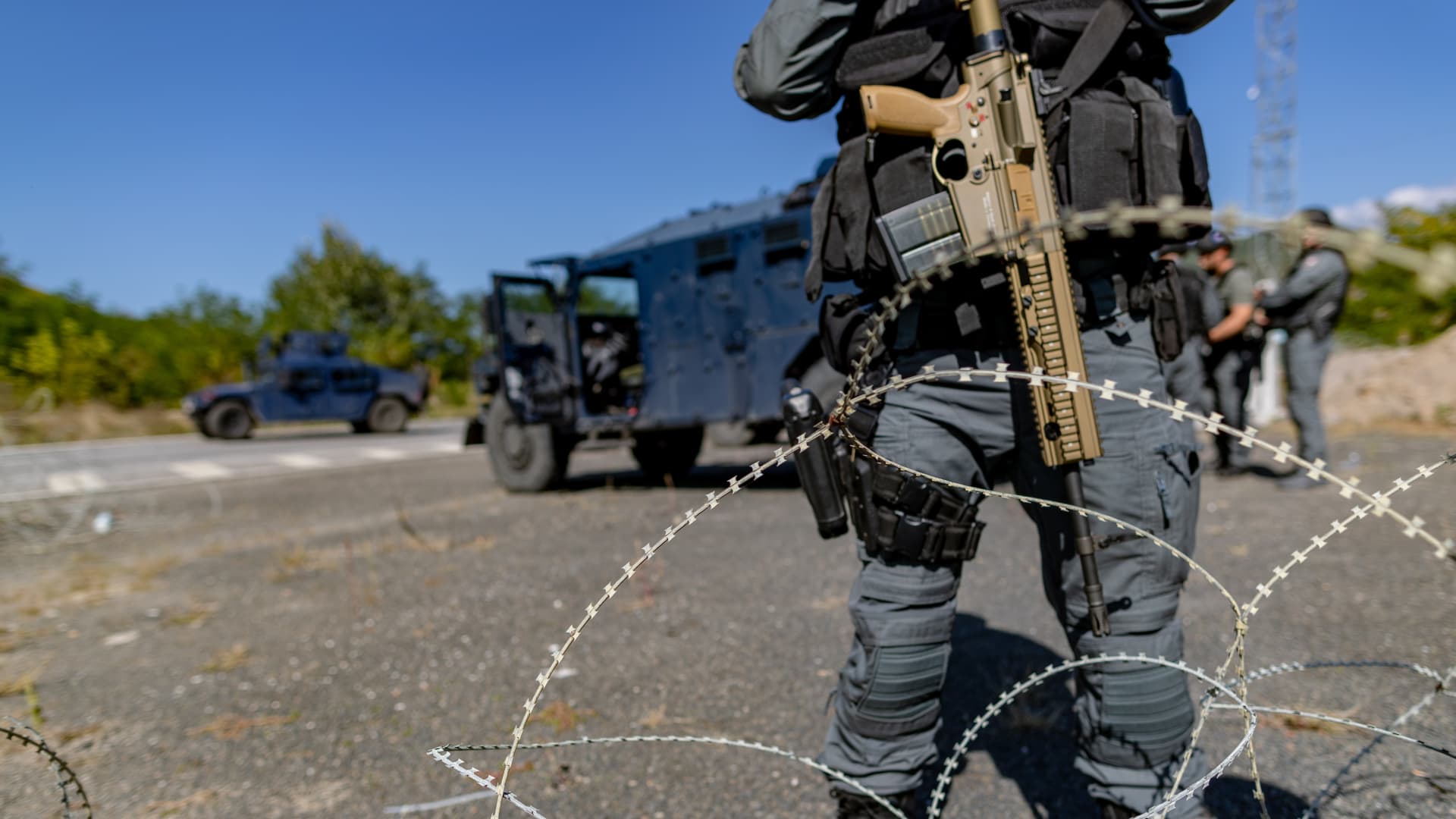
Tensions ratcheted up further over the summer and erupted in late September following a shoot-out between a heavily armed group of ethnic Serbs and Kosovo special police forces in the northern Kosovo village of Banjska in which one police officer and three gunmen were killed.
NATO has had a peace-keeping mission in Kosovo since 1999 following a bloody conflict between ethnic Albanians opposed to ethnic Serbs and the government of Yugoslavia in 1998. The military alliance reacted to the September incident by deploying additional peacekeeping troops to the region, while Serbia bolstered its military presence along its border with Kosovo.
The move prompted alarm among U.S. and European officials who expressed deep concern over the violence and “unprecedented” buildup of military forces there, as the White House described it.
Serbia denied increasing military mobilizations near the Kosovo border and said it had no intention to invade. However, earlier this week, senior Serbian military officials said the number of troops along the border had been halved to around 4,500, admitting they had bolstered the military presence to around double that figure in the aftermath of the violence in Banjska.
Serbian President Aleksandar Vučić also looked to reassure the West, telling the Financial Times in a statement last weekend that he had no intention of ordering military forces to cross the border into Kosovo, stating that this would be counter-productive for Belgrade’s aspirations to join the EU.
“Why this would be beneficial for Belgrade?” Vučić said. “What would be the idea? To destroy our position we have been building for a year? To destroy this in a day? Serbia does not want war,” he said, according to the newspaper.
Despite these assurances, defense analysts say the situation in the region is like a tinderbox, with the potential to ignite with the slightest of sparks.
“From zero land wars in Europe, we could conceivably be looking at two very shortly,” Ian Bremmer, the founder of the Eurasia Group, said in a note Monday.
He likened the tensions to the recent lightning-fast conflict between Armenia and Azerbaijan, which culminated last month with the Azerbaijani military seizing the disputed region of Nagorno-Karabakh in a rapid offensive with little outside intervention.
“You have a long-simmering and unsustainable status quo being challenged by the dominant military, looking to see if anybody else cares enough to intervene,” Bremmer said.
“In this case, that’s NATO — less distracted than Russia, and much more likely to intervene directly — but the prospects of an invasion have gone way up over the past few days.”
Engjellushe Morina and Majda Ruge at the ECFR think tank said last week that “violent incidents in the north have undermined the already difficult dialogue process between Serbia and Kosovo over the last year.”
“Serbia’s president Aleksandar Vucic has used the violence to challenge Kosovo’s authority in the north and push for the autonomy of the four northern municipalities, which would allow Serbia to interfere in Kosovo’s domestic affairs through its proxies.”
Morina and Ruge noted that Vucic characterized the latest violent incident in northern Kosovo as a legitimate act of resistance by local Serbs, but that the type and amount of weapons seized after the incident “suggested this was a bigger, coordinated combat operation with the aim to destabilise the region.”
‘The optics are troubling’
Land-locked Kosovo, which is surrounded by Serbia, North Macedonia, Albania and Montenegro, has found itself at the heart of ethnic tensions in the Balkans for centuries, but the breakup of socialist federation Yugoslavia in 1992 set in motion one of Europe’s more recent, deadliest conflicts.
Tensions between Serbia and ethnic Albanians culminated in the 1998 Kosovo war between Yugoslavia forces, led by Serbia, and a Kosovo-Albanian rebel group who opposed the Serbian authorities and oppressive policies of Serb leader Slobodan Milošević.
Hundreds of thousands of Kosovo Albanians were displaced by the conflict and numerous war crimes were committed by both sides, although the majority were attributed to Serbian and Yugoslav government forces.
The conflict ended when NATO intervened in 1999, launching air strikes on Yugoslav armed forces until their withdrawal from Kosovo. NATO’s aerial bombing campaign remains controversial to this day although it is credited with bringing the war to an end.
Kosovo declared itself independent from Serbia in 2008, a proclamation that Serbia rejected, and tensions have simmered ever since, not helped by the election of nationalist leaders in both Serbia (President Vučić) and Kosovo (Prime Minister Albin Kurti).
Nonetheless, Serbia has aspirations to join the EU and is unlikely to want to jeopardize this, or to tempt a direct response from NATO, according to Andrius Tursa, Central and Eastern Europe advisor at risk consultancy Teneo.
“A direct military offensive by the Serbian army on northern Kosovo is very unlikely due to the presence of NATO peacekeepers and the risk of punitive Western sanctions as a result of such action,” Tursa said in a note Tuesday.
“[But] from a political perspective, saber-rattling at a time when Belgrade faces uncomfortable questions surrounding the Banjska attack has increased Western perceptions of Serbia as a destabilizing actor.”
In any case, the optics are troubling for Belgrade, according to Tursa.
“Beyond the pressing need for de-escalation, the prospects for a more sustainable resolution of the long-standing conflict between the two sides is dim, especially with nationalist leaders such as Vucic and Kosovo’s Prime Minister Albin Kurti remaining in power.”
He added that an agreement earlier this year aimed at normalizing relations had so far proved ineffective and neither side appears ready for compromises on “fundamental issues such as Kosovo’s sovereignty and ethnic minority rights in northern Kosovo.”
Read the full article here