



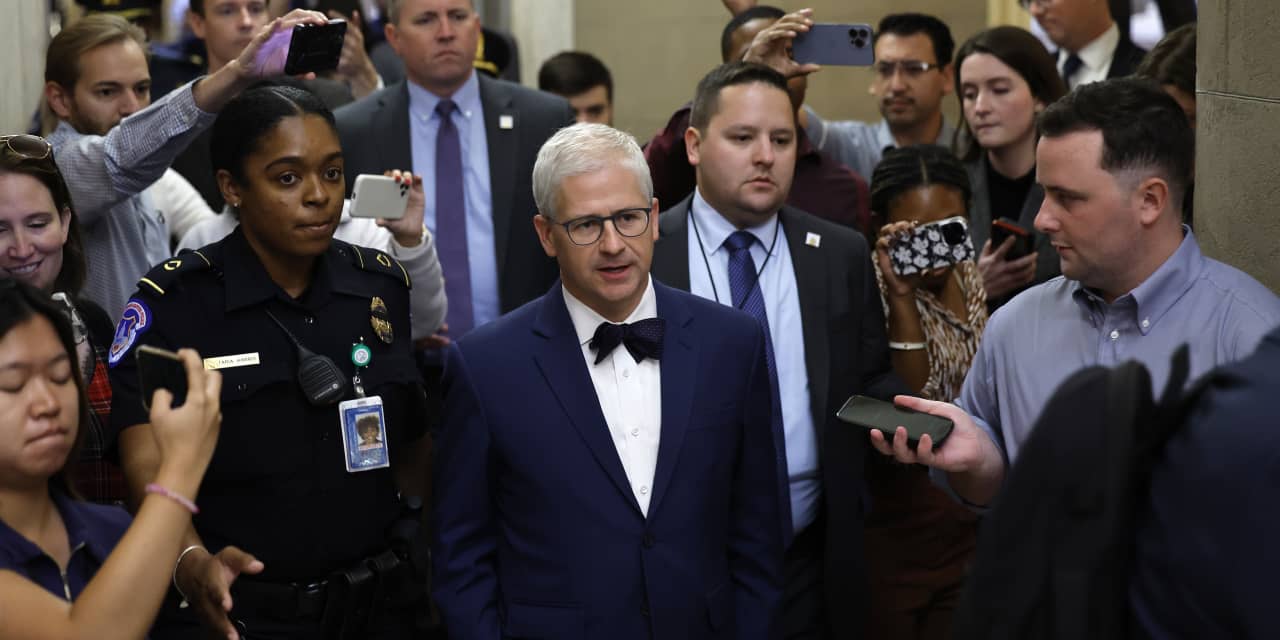
House Speaker Pro Tempore Patrick McHenry (R., N.C.) is pursued by reporters on Oct. 4, 2023 in Washington, D.C. Congressional experts are debating the extent of his powers.
Chip Somodevilla/Getty Images
Exactly which way Washington’s latest political chaos cuts for investors depends on how closely you want to look. Zoom into the halls of Congress, and you’ll find an era of unprecedented partisanship. Pull back a bit, and there’s some room for optimism—just as long as you don’t go too far.
Let’s start with the fireworks show, because it is truly spectacular. On Tuesday, for the first time in American history, the House removed its speaker. With the government funded only through Nov. 17, there’s a serious risk that the next thing the government does will be to shut down by default. “That threat is likely to increase equity volatility,” writes Tan Kai Xian of Gavekal Research in a note, since government data will be delayed and otherwise-reliable spending will get sucked out of the economy.
That said, if the prospect of political chaos is surprising to you, then you haven’t been paying attention to politics all year, and maybe this isn’t the time to start messing with your portfolio allocation. It has been clear since the 118th Congress was sworn in last January that a tiny Republican House majority would have difficulty coming up with unified positions. Even so, Congress has largely kept out investors’ way, because there are still overall majorities in favor of basic government functioning. Congress has agreed to raise the debt ceiling, agreed on some long-term spending reductions, and even chosen to keep the government open while Republicans hash out their differences.
Republicans will attempt to elect a new speaker next Wednesday. Whoever has the misfortune of taking the job will face the same rivalries that led to the ouster of California Rep. Kevin McCarthy. It’s even possible no one will succeed McCarthy, and that the House will limp along under the interim speakership of North Carolina Rep. Patrick McHenry, whom McCarthy designated as his successor under rules agreed to after the Sept. 11 attacks.
That scenario might not be as frightening as it seems. The origin of McHenry’s emergency powers makes a difference, says Molly Reynolds of the Brookings Institution, speaking at an American Enterprise Institute event on Wednesday. The idea that led to the designation of an interim jobholder, called the speaker pro tempore, was that in the event of a Sept. 11-level catastrophe, it would be intolerable if Congress couldn’t do anything. “I would put myself in the camp that the speaker pro tem, McHenry, has the full powers of the speakership with the possible exception of sitting in the line of succession,” Reynolds said.
Congress experts will keep debating the worst case of what a speakerless House could do if funding ran out. But like the debt ceiling, the politics of failure is so ugly that Congress is likely to find some way to muddle through. A shutdown might happen, and many analysts even think a temporary one is likely. But that’s been true all year, and the unprecedented congressional coup doesn’t materially change the dynamics as far as investors are concerned.
To be sure, those dynamics are messy, as a glance at the markets’ challenging week will tell you. “Capital markets continue to grapple with a tug of war between macroeconomic and microeconomic forces,” write Allianz’s Ludovic Subran and a team of analysts in a note Wednesday. For now, they write, investors are continuing to bet that companies’ balance sheets will remain strong even as the uncertainty mounts.
The politics, as wild as it is, even suggests that’s a decent bet. The previous Congress passed what amounts to a long-term stimulus package in the form of spending on infrastructure, semiconductors manufacturing, and clean energy.” That’s likely to continue past the November 2024 presidential election, says Charles Myers, a partner at political-analysis firm Signum Global Advisors. “Even if a Republican wins, they’re not going to roll any spending back. No one ever does. You just blame the previous administration for fiscal irresponsibility.” Myers’s prediction: The next president inherits a booming economy.
That said, keep zooming out and the story starts to get ugly again. Fiscal irresponsibility is going to matter more. The era of low interest rates is over, and Washington hasn’t quite got its head around that problem yet. “Like a shortsighted home buyer, Washington never locked in those low interest rates,” points out Brian Riedl of the Manhattan Institute. The average maturity of federal debt is just 76 months, he says. It will need to be rolled over at higher rates, raising the cost of all that debt.
The nation’s intense political polarization is making that problem worse. But while inflation and rising federal debt might be boiling all of us just like the proverbial frog in the pot, Congress has at least done us the favor of loudly reminding everyone that we’re about to get cooked. And it had the good manners for once to do so while the government was actually open.
It could be worse. Unless, of course, you want to be speaker of the House. Then you’re really in for it.
Write to Matt Peterson at [email protected]
Read the full article here