


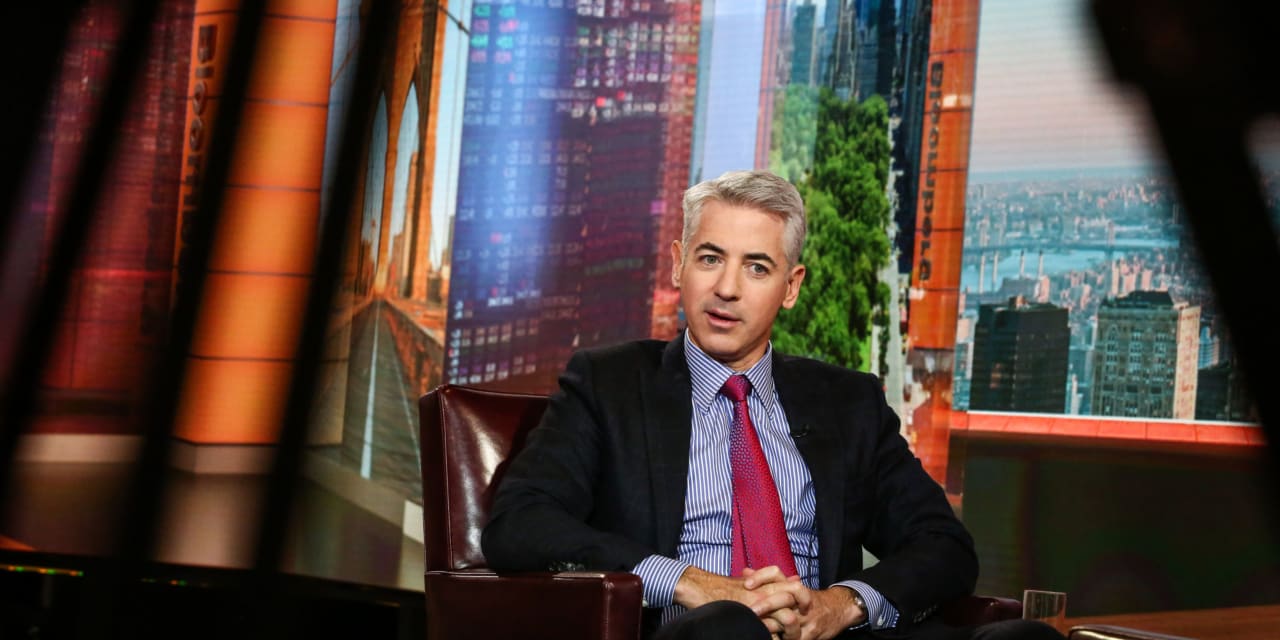
Bill Ackman, the hedge fund manager and activist investor, told The Wall Street Journal that he would be interested in a deal with Elon Musk’s X, formerly known as Twitter, to take part of the social media company public via his special purpose acquisition rights company, or SPARC.
The billionaire CEO of
Pershing Square
Holdings (ticker: PSH) received U.S. regulatory approval for a SPARC, a new variation of SPACs, that would aim to merge with a private company looking to raise at least $1.5 billion, according to a filing on Friday. Ackman said he hasn’t reached out to Musk and doesn’t know if X is interested.
This isn’t Ackman’s first try to make a deal through a blank-check company. In the summer of 2020, he raised $4 billion through a SPAC—the largest at the time—and intended to use the jumbo SPAC to purchase a 10% stake in
Universal Music Group
(UMG), the world’s largest record label behind Taylor Swift, Lil Wayne, and Lady Gaga.
But the billionaire had to pull back from the deal in 2021 after the Securities and Exchange Commission raised concerns about the complex transaction. Ackman liquidated all shares in 2022, returned the funds to investors, along with purchasing warrants for the new SPARC. It was the largest payback in the history of SPAC.
While a SPAC raises money from investors before finding a company to merge with, Ackman’s new SPARC would identify a target company first. Investors with the warrant to buy in would then decide whether to exercise or sell their rights in the following days. They can trade those rights on an over-the-counter market, The Journal reported.
It is unclear how likely Ackman can seal a deal with Musk, who paid $44 billion to take X, then Twitter, private last year. Musk had said he would take the firm public again a few years later. Ackman told CNBC that X’s heavy debt load—about $13 billion—could be a good reason why Musk might want to agree to the deal and make part of X public again.
But if history is any indication, large-size SPACs—even if they could successfully find a merger target to go public—are very risky.
Electric vehicle start-up Lucid Group (LCID) completed a SPAC merger in July 2021 and fetched $4.5 billion in fresh capital that valued the firm at $24 billion. Since its debut, shares of the Saudi-owned, California-based company (LCID) have declined 77%.
Singapore-based
Grab Holdings
(GRAB), the Southeast-Asian equivalent of
Uber
Technologies (UBER), went public through a SPAC deal in December 2021, in which Grab raised $4.5 billion and was valued at nearly $40 billion. The shares are now trading 60% below the IPO level.
The nearly 200 companies that went public via SPAC in 2021 traded at an average of 64% below IPO prices one year later, according to Jay Ritter, a University of Florida finance professor who tracks the new issues market. The 101 SPAC IPOs in 2022 declined an average of 59% 12 months after their public debut.
If part of X were to go public again, it would likely be valued at far below the $44 billion Musk paid for.
Revenue have fallen by nearly 60% from a year ago, the New York Times reported in June citing internal presentations. Advertisers are spooked by the hate speech and pornography on the social network, as well as ads featuring online gambling and marijuana products, insider sources told the paper. The company’s heavy debt also likely won’t play well with public investors.
SPACs became a popular vehicle for public listing during the Covid-19 pandemic since they are easier, take less time, and face less regulatory scrutiny. At the peak, 248 firms went public through SPACs in 2020, and 613 in 2021, raising $246 billion in total. That’s nearly half the total amount of money raised through IPOs in those two years.
But as SPACs drew tremendous investor interest, regulators became wary that the deal type favors insiders and sponsors of the deals, and allows them to make huge profits off the backs of investors. The choppy stock market and the central bank’s tightening monetary policy didn’t help, which means less cheap money on the market waiting to be invested.
Facing challenges both raising funds and finding the right merging target, many fewer SPACs have gone public in recent years—only 86 in 2022 and 22 so far in 2023, raising about $36 billion in total. SPACs typically have two years to buy a company, or they must return the money they raised to shareholders.
Of course, a SPARC is not a SPAC, and Pershing Square’s filing claims that the former should do a better job of protecting investors than the latter. With a SPAC, investors provide money up front, which a sponsor then uses to find an appropriate merger target. The sponsor is incentivized to complete the deal before the two-year deadline even if its public investors could potentially lose money. And many times, sponsors made money selling their shares regardless of what happened to the stock price after a completed merger.
SPARCS, though, don’t require upfront money, which means investors don’t have their cash tied up while waiting for a deal. What’s more, they only opt into a deal once they know the target company instead of opting out by redeeming shares. SPARCS have a longer deadline to complete the deal—up to 10 years—compared with the two- to three-year time frames for most SPACs. The sponsor can only sell their shares to profit from the deal when prices are 20% higher three years after the merger. This better aligns the interests of sponsors and investors and incentivizes sponsors to find a target that should appreciate in value over the long term.
It sounds nice. Time will tell if it works well in practice.
Write to Evie Liu at [email protected]
Read the full article here