


• Home
  • News
  • Personal Finance
    • Savings
    • Banking
    • Mortgage
    • Retirement
    • Taxes
    • Wealth
  • Make Money
  • Budgeting
  • Burrow
  • Investing
  • Credit Cards
  • Loans

Subscribe to Updates

Get the latest finance news and updates directly to your inbox.

Top News

These 4 Banks Are Still Offering Close to 5% (But Not for Long)

December 20, 2025

AI financial advisors are coming and they may outperform the humans guarding your money

December 20, 2025

How to Spot a Dangerous Business Partner Before It Costs You

December 20, 2025
Facebook Twitter Instagram
Trending
  • These 4 Banks Are Still Offering Close to 5% (But Not for Long)
  • AI financial advisors are coming and they may outperform the humans guarding your money
  • How to Spot a Dangerous Business Partner Before It Costs You
  • How Putting Profitability Over Ethics Sabotages Your Success
  • You Don’t Need Followers to Make Money Online. Here’s Proof.
  • Employee Perk Programs Are Vital Now — How to Implement Them Smoothly
  • Car Insurers Are Charging Single and Divorced People More. Is This Fair? Here’s What to Do Either Way.
  • Why Boring Bond ETFs Are the Surprise Portfolio Winner for 2026
Saturday, December 20
Facebook Twitter Instagram
iSafeSpend
Subscribe For Alerts
  • Home
  • News
  • Personal Finance
    • Savings
    • Banking
    • Mortgage
    • Retirement
    • Taxes
    • Wealth
  • Make Money
  • Budgeting
  • Burrow
  • Investing
  • Credit Cards
  • Loans
iSafeSpend
Home » Are We Destined For Dissatisfaction?
Personal Finance

Are We Destined For Dissatisfaction?

News RoomBy News RoomOctober 8, 20230 Views0
Facebook Twitter Pinterest LinkedIn WhatsApp Reddit Email Tumblr Telegram

Fresh off writing about how the extensive Harvard study on human development shows us how we can invest in our personal happiness, I read a snippet in a much-anticipated new book that illuminates quite the opposite—how we can use financial planning to decrease our happiness and strip ourselves of the joy in life that is there for the taking.

In Clear Thinking, Shane Parrish writes:

We tell ourselves that the next level is enough, but it never is. The next zero in your bank account won’t satisfy you any more than you are satisfied now. The next promotion won’t change who you are. The fancy car won’t make you happier. The bigger house doesn’t solve your problems. More social media followers won’t make you a better person.

He refers to this type of conditional, comparative living—the way, I’d argue, most of us think much of the time—as “happy-when” thinking. “Happy-when people are never actually happy. The moment they get what they think they want,” Parrish warns, “having that thing becomes the new norm, and they automatically want more.”

So, are you a “happy-when” person?

  • I’ll be happy when I buy that house.
  • I’ll be happy when I drive that car.
  • I’ll be happy when I get that job.
  • I’ll be happy when I marry that person.
  • I’ll be happy when my 401(k) reaches that number.
  • When I write that book, get that many likes, rack up that number of views, achieve that title, host that party, get invited to that party, go on that vacation, win that competition, lose that weight.

One could argue that we all are. The behavioral economics theory of hedonic adaptation suggests that it may be in our hard wiring—that our brains persistently seek out newer and more rewarding experiences and that our tendency to constantly compare ourselves to others (and even our past self) helps ensure our drive to survive.

Does this suggest we are destined for dissatisfaction?

Not necessarily, but when we understand the why behind our “fast thinking,” our instinctive impulsions, we can undertake practices to deconstruct our thinking, to slow our processing down, to recognize our subconscious and balance it with rationale.

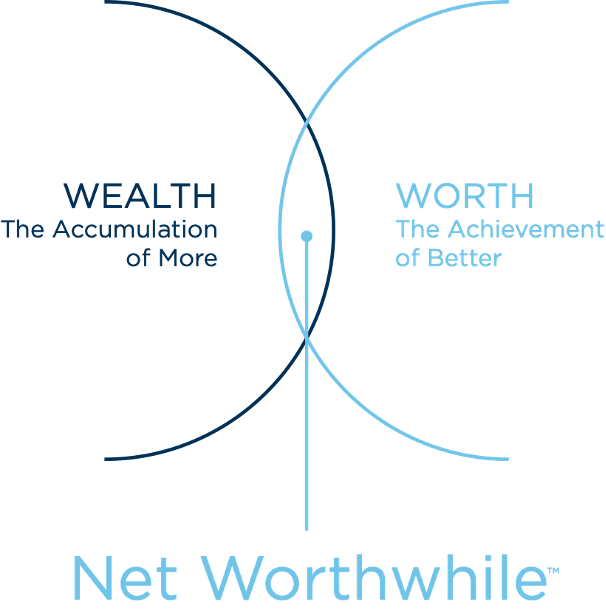
One of the ways I’ve explained this to both clients and financial advisors is through the explanation of “Net WorthwhileTM,” a helpful repositioning of our possessions in light of our aspirations.

Net Worthwhile TM is “the intersection of the accumulation of more and the achievement of better.” It infuses our wealth with worth and gives purpose to our planning, all by helping us view what we possess through the lens of what inspires us. In so doing, even the most confounding and complex financial dilemmas can be transformed into simpler solutions when we acknowledge what—and who—are most important to us in life.

Note that this is not an exercise in demonizing the accumulation of personal resources. As we’ve addressed, that drive for accumulation is an innate human longing that can be used to our advantage when we understand its role. And it is not just the tangible assets counted on a balance sheet that we must consider in our “portfolio,” but also the intangible resources that could be argued as even more valuable—our time, influence, energy, and relationships.

Yet, if we haven’t ascribed a purpose to these resources, translating financial planning into the language of life, we may find ourselves accumulating for the sake of accumulation itself—making that which is a serviceable means an insufficient end. Or, as Shane Parrish puts it, “And while we’re busy running on the treadmill chasing after all the things that won’t make us happy, we’re not pursuing the things that really matter.”

Therefore, I’ll leave you with the implicit question that we too rarely ask, the answer to which can help give us the meaning and purpose we need to activate our wealth and pursue Net Worthwhile TM:

What is it in life that really matters to you?

Read the full article here

Share. Facebook Twitter Pinterest LinkedIn Tumblr Email

Related Articles

AI financial advisors are coming and they may outperform the humans guarding your money

Personal Finance December 20, 2025

Pain Power

Savings December 18, 2025

2025 Year-End Financial Checklist for Wealthy Investors

Retirement December 9, 2025

Foundations Of Health And Longevity In Retirement

Retirement December 6, 2025

Trump Accounts vs. Baby Bonds: Who Truly Benefits?

Retirement December 5, 2025

Balancing Health, Longevity and Finances

Retirement December 4, 2025
Add A Comment

Leave A Reply Cancel Reply

Demo
Top News

AI financial advisors are coming and they may outperform the humans guarding your money

December 20, 20250 Views

How to Spot a Dangerous Business Partner Before It Costs You

December 20, 20250 Views

How Putting Profitability Over Ethics Sabotages Your Success

December 20, 20250 Views

You Don’t Need Followers to Make Money Online. Here’s Proof.

December 20, 20250 Views
Don't Miss

Employee Perk Programs Are Vital Now — How to Implement Them Smoothly

By News RoomDecember 19, 2025

Entrepreneur Key Takeaways In today’s climate, perk programs are no longer optional. They’re a business…

Car Insurers Are Charging Single and Divorced People More. Is This Fair? Here’s What to Do Either Way.

December 19, 2025

Why Boring Bond ETFs Are the Surprise Portfolio Winner for 2026

December 19, 2025

Why Rejection is Critical to Your Personal Success

December 19, 2025
About Us

Your number 1 source for the latest finance, making money, saving money and budgeting. follow us now to get the news that matters to you.

We're accepting new partnerships right now.

Email Us: [email protected]

Our Picks

These 4 Banks Are Still Offering Close to 5% (But Not for Long)

December 20, 2025

AI financial advisors are coming and they may outperform the humans guarding your money

December 20, 2025

How to Spot a Dangerous Business Partner Before It Costs You

December 20, 2025
Most Popular

Employee Perk Programs Are Vital Now — How to Implement Them Smoothly

December 19, 20252 Views

Car Insurers Are Charging Single and Divorced People More. Is This Fair? Here’s What to Do Either Way.

December 19, 20252 Views

Before You Hire Globally, Run This 5-Point Audit

November 3, 20252 Views
Facebook Twitter Instagram Pinterest Dribbble
  • Privacy Policy
  • Terms of use
  • Press Release
  • Advertise
  • Contact
© 2025 iSafeSpend. All Rights Reserved.

Type above and press Enter to search. Press Esc to cancel.