



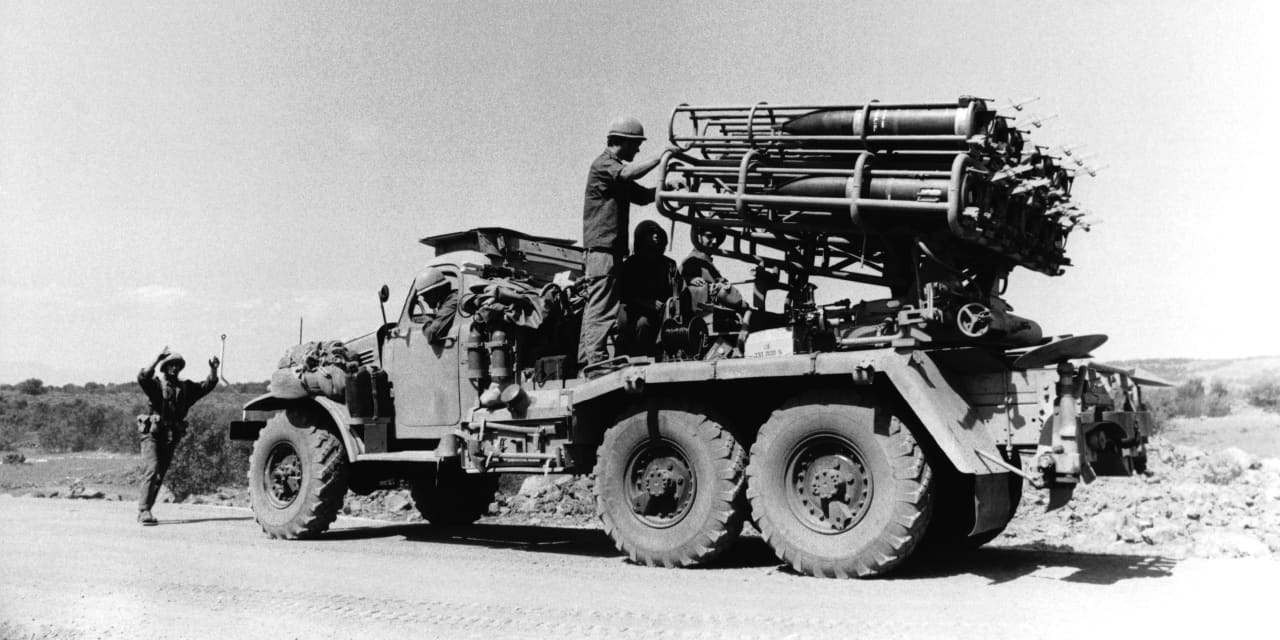
Coming almost on the exact 50th anniversary of the Yom Kippur War, the attack on Israel by Hamas conjures comparisons with a half-century ago. The consensus view is that it is different this time, and for once the Wall Street cliché is right.
In some ways, the U.S. is less vulnerable, notably in terms of energy security. But in others it is less secure, in its defense capabilities and fiscal stability, to meet the challenges of the increasingly dangerous geopolitical situation.
The U.S. is no longer as dependent on foreign oil. Back in the 1970s, the U.S. was the world’s biggest petroleum importer, which made the nation vulnerable to the oil embargo imposed by OPEC. Crude prices roughly tripled, to $12 a barrel from $4, levels that seem shockingly low today.
But then came the gasoline lines, a symbol of the economic malaise that came to be known as stagflation. In the wake of the oil shock, the U.S. economy contracted 3%, adjusted for inflation, sending unemployment up to 9%, while inflation topped 12% in 1974. What didn’t inflate was stock prices: The
Dow Jones Industrial Average
shed 45% in the brutal bear market of 1973-74.
Following the attacks of the past weekend, crude oil prices popped, but couldn’t hold their gains as the week progressed. The benchmark U.S. crude futures contract jumped about $4, to the mid-$86 range, before relinquishing most of that gain by Thursday, unable to break the downtrend since the recent peak of $93.68 in late September.
Importantly, instead of running a huge energy trade deficit owing to oil imports, the U.S. has become a net exporter of petroleum products. That’s due to the shale revolution, which has boosted U.S. oil production to a record 13 million barrels a day.
There is a different deficit now—that of the budget. Given the geopolitical challenges that the U.S. faces, this arguably is more important.
The red ink in the fiscal year ended in September topped $2 trillion, after the effects of the proposed student-loan forgiveness plan rejected by the Supreme Court are excluded. This is the more relevant measure because it represents Washington’s actual cash shortfall, according to Strategas’ Washington analysis team led by Daniel Clifton.
As the firm’s chief strategists, Jason De Sena Trennert and Ryan Grabinski, write in a separate client note, the federal deficit previously topped 5% of GDP only in years when unemployment exceeded 7%, symptomatic of weak economies. Despite a historically low jobless rate in the mid-3% range, Washington ran up red ink in excess of 5% in the fiscal year just ended, and is projected to continue to do so. How much might the deficit blow out if, or when, unemployment rises from the long-predicted recession?
Given the global stresses, however, the deficit might have to be subordinated to security interests, according to an insightful analysis from Daleep Singh, chief global economist and head of macroeconomic research at PGIM Fixed Income, the asset-management arm of Prudential Financial. Perhaps more important for this discussion than his current title is the most recent line on his CV: former deputy national security adviser for international economics and deputy director of the National Economic Council for the Biden administration.
Investors should consider second-order effects from the Hamas-Israel conflict, Singh writes: “National security experts are abuzz with discussion about whether the U.S. defense-industrial base has sufficient throughput capacity to back Ukraine, Israel, and possibly Taiwan with artillery and munitions in a simultaneous and extended conflict scenario. The unanimous and emphatic answer from experts is ‘no,’ which to me just underscores the likelihood of a period of fiscal dominance in which deficits are mostly disregarded and interest rates must adjust to a higher equilibrium.”
Fiscal dominance has become the new buzzword to describe how massive budget deficits are overwhelming monetary tightening by the Federal Reserve. In past cycles, fiscal policies had relatively less impact; budget deficits only widened hugely when unemployment rose and private-sector spending receded.
Massive budget deficits are now a permanent fixture and increasingly intractable owing to rising interest expenses, Trennert and Grabinski point out. Treasury auction sizes are slated to ramp up by 24% in 2024, John Brady, managing director of global institutional sales at institutional broker R.J. O’Brien points out in a client note.
That’s another difference from the 1970s. Back then, the so-called petrodollar surpluses were said to be recycled to oil-consuming debtor nations. Nations that formerly recycled surpluses into the U.S. markets now are pulling back, with China selling Treasury securities and Japan slowing its purchases. The Strategas strategists posit the next president will likely have to choose between fiscal austerity or accepting structurally higher levels of inflation and interest rates.
What they don’t say is that the most likely candidates in next year’s presidential election are the two biggest budget busters in history. Brady points out the administration of former President Donald Trump added $7.5 trillion to future deficits, including $4 trillion in pandemic-related relief. President Joe Biden’s administration so far has added $4.8 trillion in red ink, including $2.5 trillion for Covid-19 relief, through 2031. (Those figures come from the Committee for a Responsible Federal Budget.)
But what is even more daunting is fiscal constraints in a fraught world, as PGIM’s Singh points out. Hobson’s choice will be to accept the higher borrowing costs from increasing security expenses as geopolitical tensions increase, the budget be damned.
Write to Randall W. Forsyth at [email protected]
Read the full article here