




Entrepreneur
You’re reading Entrepreneur India, an international franchise of Entrepreneur Media.
With the rise in the number of HNIs in India, there has also been an increase in their interest in seeking personalized solutions to help them diversify and grow their wealth (at a much higher rate than commonly available investment options). Few years back, they had only portfolio management services (PMS) to manage their wealth and generate returns higher than the market or mutual funds. But in the last few years, Alternate Investment Funds (AIFs ) have become a preferred choice for many wealthy individuals. The figures substantiate this. As of March 2023, the AUM of AIFs totalled INR 8.34 lakh crore according to SEBI data. In March 2019, that figure was INR 2.82 lakh crore, which is an increase of more than 4x in the last five years. Also, the industry has witnessed a steep increase in the number of AIFs in the country from mere 366 in 2018 to above 800 in 2022.
So what is driving the growth of AIFs? “The growth in AIF commitments is a cumulative effect of multiple factors. As existing managers raise larger funds and new managers emerge in every vintage, we are seeing growth in the participation of domestic capital being committed to AIFs. Also, there is a clear refinement in the quality of founders with know-how from winners and downfalls that the PE/ VC ecosystem has seen in the last decade and a half,” says Vaibhav Laxmeshwar, Vice President, Alternative Investments & Fund of Funds, Waterfield Advisors.
According to industry experts, the removal of LTCG tax benefits in debt mutual funds is also playing a key role in the popularity of this investment option, “Debt mutual funds were highly favored for providing regular fixed income, along with LTCG tax benefits and indexation advantages, making them an appealing choice for investors, especially those in higher income tax brackets. However, these benefits are no longer applicable to debt mutual funds. This significant change has triggered a reassessment of investment portfolios, particularly among sophisticated investors such as HNIs and family offices. And prompted a quest for alternative fixed-income options,” said Anuj Kapoor, Partner and Founder, Investment Banking, Upwisery Capital Advisors.
Concurs Daniel GM, Founder, pmsbazaar. com, “LTCG on debt funds will drive incremental demand for AIF like private credit as it provides higher gross yields, hence post tax returns will still be lucrative.”
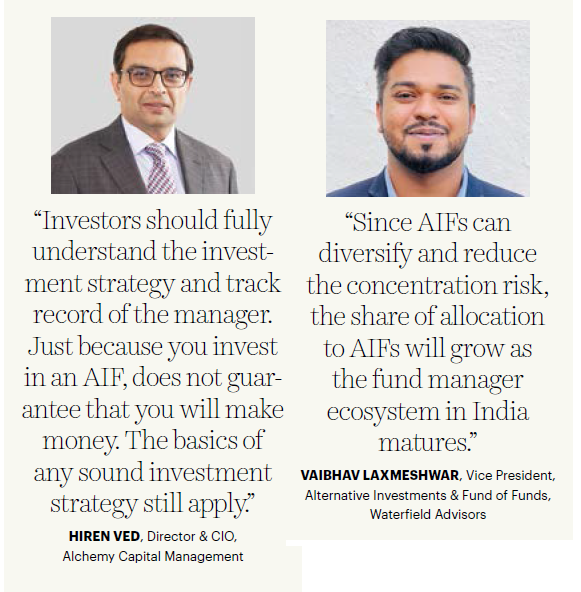
Industry insiders expects share of allocation towards AIFs to grow further. “Since AIFs can diversify and reduce the concentration risk, the share of allocation to AIFs will grow as the fund manager ecosystem in India matures,” says Laxmeshwar.
WHAT ARE AIFs
Introduced in 2012 by the Securities Exchange Board of India (SEBI), an alternative investment fund (AIF) is a special type investment fund that invests in assets beyond traditional investment avenues listed stocks, bonds and cash. AIFs are typically managed by professional fund managers and are regulated by the Securities and Exchange Board of India (SEBI).
There are broadly three types of AIFs in the market. While Category I comprises angel funds, social impact funds, small and mid-size enterprise (SME) funds and infrastructure funds. Category II comprises private equity, venture capital and debt funds. Cat II AIFs have the lion’s share in the AIF industry at 83%. Lately, the category is seeing investment in lower-rated companies. The funds are drawn to these companies because of the immense growth potential they hold. And the allure of higher yields when compared to other debt products. Most performing credit funds are targeting gross yield in the range of 15%-18% and net yield (after adjusting for expenses, fees and tax) in the range of 9%-12%. This gives an opportunity to earn slightly higher returns with limited risk exposure. “While investing in non-rated or low-rated companies may promise the potential for higher returns, it also entails heightened uncertainty and exposure to credit risk,” adds Kapoor.
This category also has AIFs which invest in the units of other AIFs and are called fund of funds AIFs. In 2021, multi-family office Waterfield Advisors launched a fund of fund AIF to raise INR 500Cr with the first close done in June 2021 at INR 200Cr. The fund oversubscribed, with the final close marked at INR 540 Cr. Other such AIFs were launched by IIFL group, and the ASK group. Lately, HDFC Mutual fund also launched a fund of fund AIF. The last one–Category III funds typically invest in public markets such as hedge funds.
NOT A MASS PRODUCT
Unlike mutual funds which are a mass product, AIF falls into the category of a class product with a minimum investment limit at INR 1 crore per investor. Also, AIFs come with a minimum lock-in period of three years. And the number of investors in every scheme is restricted to 1000, except angel funds, where the number of investors goes up to 49. According to experts, benchmarking is still a challenge for AIFs.
“AIF investment limit of INR 1 crore is done with a clear intention of safeguarding investors. It requires a certain level of sophistication and risk appetite,” says Daniel.
Some experts also feel that reducing the minimum capital commitment can be one of the ways to increase participation. “It will be beneficial for first-time and emerging managers, but reducing the minimum commitment limit will increase the number of LPs in the AIFs, which can be an operational challenge for the funds.” adds Vaibhav Laxmeshwar.
ADVANTAGES
Since there are no restrictive mandates on investing only in specific avenues, or in assigning weightages to specific investments, therefore, an AIF fund manager can take exposure to a wide array of investment avenues to deliver the best returns. Some AIF fund managers prefer a closed structure, which restricts the entry and exit into funds based on their own assessment of the markets and specific asset classes, giving them a better chance of delivering alpha. Take the case of Crisil’s Category I AIF benchmark, which represents the performance of the respective AIF categories at an aggregate level. It consistently outperformed the Sensex and Nifty from vintage year FY 16 to FY21.
WAYS TO INVEST
There are two ways of going about investing in AIFs. One-via a distributor and second via a registered investment advisor. While a registered investment advisor charges a fixed fee, the distributor is given a commission. However, changes have been taking place in investing landscape of this decade old instrument in the market. In April 2023, SEBI came up with a proposal of investing directly in AIFs. In the case of a mutual fund, Sebi made investing in schemes via direct plans mandatory in 2013 to reduce the additional cost to customers and the chances of mis-selling.
TAXATION
While Category I and II AIFs have been accorded a pass-through status for tax purposes (similar to other investment vehicles), there is no specific tax regime for Category III AIFs. Accordingly, Category III AIFs (which are usually setup as trusts) are taxed as per the general principles of trust taxation, which is complex and open to interpretation. The tax pass through framework for Mutual Funds, PMS, Category I and II AIF helps investors as the income is directly taxable in their hands; however Category III AIFs investors are put to a disadvantage as they do not have a tax pass through status which creates uncertainty in the amount of tax payable, risk of double taxation in some cases.
WHAT TO KEEP IN MIND
Investment strategy & Risk: If you already have exposure to the proposed strategy through your existing portfolios, it doesn’t make sense to go for it. “It’s important to buy funds that align with the investor’s investment objectives and the risk profile. They must understand fee structures and the fund’s track record,” Adhil Shetty, CEO, BankBazaar.com.
Liquidity: With AIFs liquidity could be an issue since AIFs which are involved in investing in long gestation areas such as real estate and private equity have long lock-in periods. “Category I has the longest lock-in compared to others, but one must understand that lock-in gives the fund manager the time to stay invested and generate returns. So in a way, a lock-in such products is advantageous for investors,” adds Daniel.
Fee structure: The varying fee structures can significantly impact net returns generated by the fund. Therefore, it is crucial to understand the fee and pay attention before considering it for investment.
Evaluate the fund manager’s past performance: While putting money in AIFs, it makes sense to take into account the fund manager’s experience, and look for team consistency and cohesion. This is critical as these products tend to have long lock-ins and you want the management team to be there to achieve targeted outcomes. “Investors should fully understand the investment strategy and track record of the manager. Just because you invest in an AIF, does not guarantee that you will make money. The basics of any sound investment strategy still apply,” Hiren Ved, Director & CIO, Alchemy Capital Management.
Expert recommendation: The AIF funds need specialized knowledge. Therefore, advice from investment experts is recommended as they understand the client profile and make suitable recommendations. “Given the diverse range of options with each being unique to one another and with Category III categories AIF , it can get very complex, hence guidance from an advisor is a must,” adds Daniel.
Right allocation: Like all other investments, it’s important to know how much should one allocate towards AIFs in one’s portfolio. Experts advise not allocating more than 25-30% of one’s investments in AIF.
Read the full article here