



Stocks haven’t looked this overpriced in 20 years, one Wall Street economist wrote this past week. He cites the 10-year Treasury yield, recently up to about 5%, compared with the “earnings yield” of the S&P 500 index, or the price/earnings ratio flipped upside down, which is also near 5%. As finance poindexters say, has the equity risk premium collapsed to zero? That roughly translates to: Why take a chance on risky stocks when safe bonds seem similarly priced?
The bull response is that Treasury coupons are fixed, whereas company earnings tend to grow, so for long-termers, safe bonds aren’t really on par with stocks. Also, rising bond yields like we’ve seen are commonly assumed to nudge stock valuations lower. But maybe they don’t, if the rising yields are a sign of a peppy economy and better earnings to come. BofA Securities points out that since 1945, the correlation between rising real yields and falling P/E ratios has been weak, and negative. Stick with stocks, in other words.
I guess so. But also, if you broke up with bonds a few years ago when that 10-year Treasury yield was a fraction of 1%, or if the recent outperformance of stocks over bonds has left you too stock-heavy, maybe raise your bond mix back to more ordinary levels.
Let’s focus on another point the bulls make about the S&P 500’s valuation. It has been driven higher by recent gains for seven tech giants that carry the most sway in the index—or that did until this past week, when
Tesla
(ticker: TSLA) had an earnings oopsie-daisy, and fell behind
Berkshire Hathaway
(BRK.B). More on that in a moment.
The others are
Microsoft
(MSFT),
Alphabet
(GOOGL),
Amazon.com
(AMZN), and
Meta Platforms
(META), which report results in the week ahead;
Apple
(AAPL), which is up the following week; and
Nvidia
(NVDA), which reports closer to Thanksgiving. The P/E ratio for the seven has climbed from 29 to 45 this year. Are they in a bubble?
Wall Street has a way to tell. It’s called discounted cash flow, or DCF analysis, and it’s the basis for analyst price targets and Buy, Hold, and Sell ratings.
Step 1: Predict precise free cash flows far into the future, say 10 years, even though Wall Street routinely guesses wrong on much easier measures like revenue for the current quarter.
Step 2: Choose what’s called a discount rate, which is based in part on risk, which no one has figured out how to accurately measure for stocks in their four-century history.
Step 3 onward: Use this made-up rate to calculate how much to pay today for those unknowable future cash flows. I’m leaving out some important steps, like calculating a terminal value, which involves conjecture beyond year 10, and adjusting for distant, entirely theoretical debt levels. Don’t forget to express your answer in the form of absolute certainty.
Here’s an alternative that’s less mathy and more appropriately iffy. It doesn’t have a high-finance-sounding name. I’m considering “disgruntled crash-flop electrolysis,” but I have to check the trademark status. DCFE involves starting with things we already know, like today’s price, or can safely assume, like that an investor buying shares of one of these Big Tech companies would want to be decently rewarded—say, with 12% yearly returns over the next five years. Ballpark how much free cash the company would have to be generating after those five years to be worth that price. And then sniff deeply at recent cash flow trends to decide whether such a thing is plausible, resulting in a rating of Yeah, Meh, or Nah. Think of it as a sanity check, not a market timing tool.
Take Apple, the biggest of the bunch. A 12% yearly compounded return would take its recent $175 share price to just over $300 in five years. Based on today’s market value and how the share count has been steadily declining, figure a future value of $4 trillion. At minimum, an investor might expect to see a 4% free-cash-flow yield on a mature business like that, or $160 billion a year. Not even oil monopoly Saudi Aramco is hitting those levels.
But Apple is already over $100 billion in yearly free cash. And its capital spending isn’t growing much. So even moderate revenue increases could leave it with a Brewster’s Millions situation where it’s difficult to spend the cash. (Richard Pryor, John Candy, 1985, in which a minor league baseball player has to blow $30 million in 30 days to inherit $300 million.) I rate the stock a solid Meh, bordering on a Yeah.
Microsoft, Alphabet, and Amazon are three more companies with a path to joining the $100 billion free-cash-flow club at some point within the next several years, giving the U.S. the financial equivalent of four Aramcos. Amazon has much further to climb than the others, and all carry regulatory risk, but the idea is the same: Puttering around with the numbers, today’s prices don’t look ludicrous in light of the plausible path for free cash flow. Ditto for Meta, but on a smaller scale. Its management has stopped yammering about the metaverse, started yammering about artificial intelligence, and most important, slashed spending. Free cash flow could top $30 billion this year and approach $50 billion in several years.
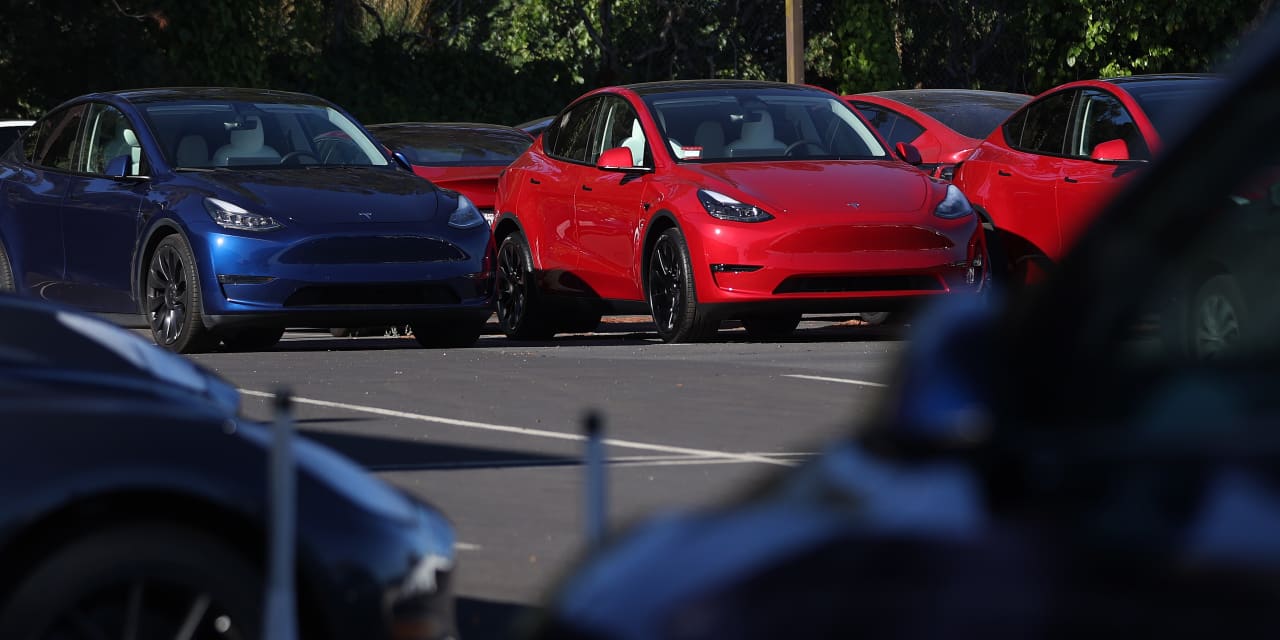
Nvidia and Tesla are more difficult. Before the pandemic, Nvidia was generating free cash like a prosperous chip maker—a few billion dollars a year. Its current value implies that within several years it will turn out a Meta-like $50 billion, or remain an incredibly fast grower, or both. It could happen—the company has one of the strongest positions in AI—but the assumptions are bold. And Tesla stock this past week skidded 9% in a day, after third-quarter results showed elevated discounting to sell vehicles. That makes the free-cash multiplication needed to justify the current price a leap. Nah for both.
On the whole, prices look elevated but not nuts. As for the equity risk premium, it’s theoretical and ultimately unknowable, but I recently gave it an imaginary squeeze and it felt modestly positive. Which is good.
Write to Jack Hough at [email protected]. Follow him on Twitter and subscribe to his Barron’s Streetwise podcast.
Read the full article here