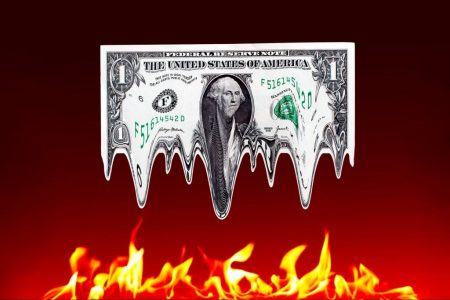




Just as profits start growing again, the economy is starting to slow, leaving one thing abundantly clear: There’s no escaping a recession.
As earnings season stumbles to an end—
Home Depot
(ticker: HD),
Target
(TGT),
Cisco Systems
(CSCO), and
Walmart
(WMT) are among the stragglers set to report this coming week—one thing is clear: The earnings recession is over. Corporate profits declined for three consecutive quarters, starting in the fourth quarter of 2022. But with 75% of the
S&P 500
index having reported, it looks like they’ll finally grow again this quarter.
David Lefkowitz, head of U.S. equities at UBS Financial Services, credits strong growth from Big Tech, the resilience of consumer spending, and a potential end to the manufacturing slowdown as reasons for the stronger results. “It’s clear to us that the earnings recession is over, as earnings are set to grow for the first time in four quarters,” he writes.
Stocks, though, haven’t reacted all that well, despite 80% of companies reporting earnings beats. The lackluster performance prompts the Sevens Report’s Tom Essaye to describe earnings as not good, but also not bad. To qualify as good, companies would have needed to raise their guidance, but instead 2024 profit estimates for the S&P 500 sit at $242 a share, near where they were before the start of earnings season.
What’s more, reports from companies like
Whirlpool
(WHR),
Align Technology
(ALGN), and
Harley-Davidson
(HOG) showed signs of waning consumer demand, Essaye writes. “[Within] the results there are anecdotal signs that consumer spending may be slowing,” he explains. “If that’s the case, then that will make us more concerned about a ‘growth scare’ in late 2023/early 2024 negatively impacting markets.”
But will it be more than just a scare? Recession spotting was all the rage in 2022, as the S&P 500 sold off, the Federal Reserve raised interest rates, and the yield curve inverted. Instead, the economy kept growing—U.S. gross domestic product increased by 4.9% in the third quarter—and the market found its footing. Recession fears were put on the back burner, if not extinguished completely, and those who stuck to a slowdown as their base case cost themselves some very solid gains.
Still, it would be a mistake to dismiss the possibility of a slowdown, as the preponderance of evidence begins to suggest that the odds of one are rising. Leading indicators continue to point to a recession, while the drop in M2 money supply continues at a pace that suggests one, too. The latest Fed Senior Loan Officer Survey showed some improvement in U.S. bank lending, but it’s still at levels that are indicative of an approaching recession, writes Deutsche Bank’s Jim Reid.
“It still feels like we’re in a race against time,” he explains. “Can lending standards improve [quickly] enough before funding becomes too restrictive or unavailable for important borrowers and tips the economy into a much more difficult situation?”
Other metrics look far more recessionary than they did 12 months ago. While new jobs continue to be created—the economy added 150,000 in October—unemployment rose to 3.9%, the highest since January 2022. That rate is half a point above the cycle low of 3.4%, which was hit in January and April.
That might not seem like a large increase, but when it occurs over a nine-month period, it typically signals a peak in the economic cycle or a recession, says Michael Darda, chief market strategist at Roth MKM. And even the fact that new jobs are being created doesn’t negate the warning sent by the unemployment rate. “Keep in mind it is not unprecedented to see positive payroll growth and GDP growth into the early stages of recession,” he writes.
And then there’s the yield curve—yes, the same yield curve that had everyone freaking out about a possible recession back in 2022. At this point, it would seem that the difference between short- and longer-term Treasuries would have lost their credibility as a recession predictor, but we’d argue that the inversion has been misinterpreted rather than faulty. While the initial inversion should put investors on watch for a recession, the real countdown begins when it reaches its maximum point. When that happens, a recession has started nine months later on average, according to Evercore ISI’s Julian Emanuel.
The maximum inversion probably occurred on March 8, when the two-year Treasury yielded 1.09 percentage points more than the 10-year. Using that date, a recession would be set to begin, well, next month. But it’s rarely so simple. Nine months is just an average, and a recession can take more or less time to make itself known—sometimes much longer. The economy needed 33 months after the max inversion in 1998 to fall into recession, while the S&P 500 went on to gain 68% before the dot-com bubble went bust.
“Recession is coming,” Emanuel writes. “But the ‘when’ could be 1Q24, as the nine-month ‘average time’ suggests, or like the 1990s it could be postponed to late 2024 or 2025.”
That’s a wide range of outcomes, but the stock market doesn’t see it that way. Analyst estimates reflect 11% growth for S&P 500 earnings, far higher than the 30% contraction that typically occurs around a recession, explains DataTrek Research co-founder Nicholas Colas, while the index trades at 18 times 2024 estimates, not the 28 times suggested by a recessionary decline. Even a mild recession, such as the one that occurred in 1990-91, caused earnings to decline 16%.
“Earnings always drop when the U.S. sees a recession,” Colas writes. “There are no exceptions to this rule.”
Rather than trying to predict the timing of a recession, we’d all be better off adjusting our portfolios for the higher probability of one. That could mean buying out-of-favor defensive sectors like utilities and staples, which have fallen 13% and 6.4% this year, respectively, or looking at an exchange-traded fund dedicated to low-volatility stocks, such as
Invesco S&P 500 Low Volatility
(SPLV) or
iShares MSCI USA Min Vol Factor ETF
(USMV), both of which have underperformed the major indexes. It could also mean taking some gains off the table and putting a little more in cash.
From here on, the game should be about risk management, not recession forecasting. “We need to be very humble about trying to make these predictions,” says Anne Vandenabeele, an economist at Capital Group.
Even if it means leaving some gains on the table.
Write to Ben Levisohn at [email protected]
Read the full article here