



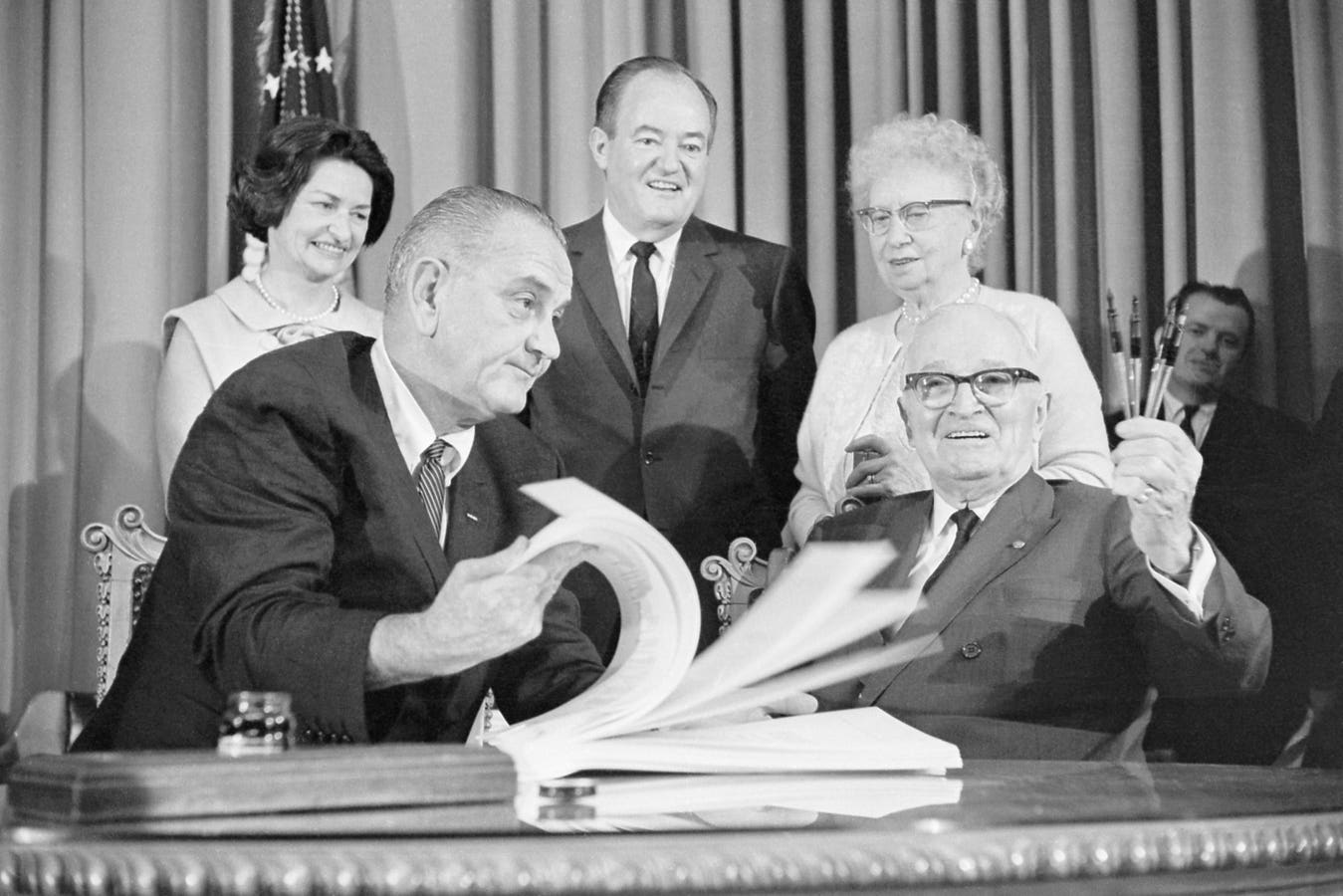
Since Congress passed the big tax and spending bill on July 3, most observers have focused their attention on its cuts to Medicaid. But the Trump Administration is quietly making big changes to Medicare, which insures nearly 70 million seniors and younger people with disabilities. Just in time for the program’s 60th anniversary.
Most direct changes are aimed at providers such as doctors, hospitals, home health agencies, nursing homes, and hospices. But the biggest immediate impact on Medicare costs may come from President Trump’s worldwide tariff increases and his promised mass deportations of immigrants.
Combined, these direct and indirect changes could alter the way older adults receive their health care, potentially in significant ways, despite President Trump’s repeated promises that he would not touch Medicare.
The Administration seems to be framing its actions to achieve three goals—to reduce fraud, increase efficiency, and refocus care on disease prevention. But some changes will increase costs and limit access to care.
Here are some of Trump’s Medicare initiatives:
Prior authorization for original Medicare. Medicare Advantage managed care plans have come under intense scrutiny, including from the Trump Administration, for routinely demanding prior approval for many treatments. But now, the Centers for Medicare and Medicaid Services (CMS) will begin requiring prior authorization for certain procedures under traditional Medicare.
It announced a six-year, six-state pilot program to require physicians to get an OK for 17 treatments and procedures. The Wasteful and Inappropriate Service Reduction (WISeR) initiative will be tested in New Jersey, Ohio, Oklahoma, Texas, Arizona, and Washington, and cover procedures such as certain back surgeries, some steroid injections for pain, knee arthroscopies for osteoarthritis, and use of certain artificial skin grafts. CMS says they all “are vulnerable to fraud, waste and abuse.”
The skin substitute story is especially interesting. The Biden Administration attempted to crack down on overuse of the product. Trump blasted that move in March and shelved the Biden rules. Now, the president has reversed course: His Administration will require prior approval before Medicare pays for the artificial skin.
CMS says it will use AI for authorizations, although it insists humans will review all decisions.
Nursing Homes. Medicare pays for post-acute care and rehab in skilled nursing facilities, usually after someone has been discharged from a hospital. CMS proposed increasing 2026 Medicare SNF payments by 2.8 percent. And the 2025 budget bill effectively repealed Biden’s minimum staffing rules for nursing homes.
Trump also issued an executive order in January calling for substantial deregulation of nursing homes and other Medicare providers. Look for CMS to roll back Biden rules on ownership transparency and quality and safety reporting.
Home Care: CMS proposed cutting by 6.4 percent, or more than $1 billion, 2026 Medicare payments to home health agencies. Those cuts have generated opposition even from congressional Republicans.
At the same time, the Labor Department proposed allowing home care agencies to pay workers less than the federal minimum wage of $7.25/hr and exempting them from having to pay for overtime unless their states explicitly require it. The new rules would overturn Obama Administration policies.
Immigration. Trump’s promised mass deportations will further tighten the supply of direct care workers, both for facility- and home-based care. That inevitably will drive up costs for Medicare and consumers.
Medicare Savings Programs. The budget bill made it tougher for low-income seniors to enroll in MSPs, which help cover premiums and other out-of-pocket Medicare costs.
More Financial Risk: For years, original Medicare has used both carrots and sticks to nudge doctors and health systems away from volume-based payments and towards payment for good outcomes rather than for the number of procedures.
This shift has been happening for well over a decade, but look for the Administration to accelerate the trend. CMS is likely to increase both penalties and rewards for doctors, nursing homes, home health agencies, physical and occupational therapists, and other providers.
GUIDE: One Biden-era initiative that appears to have strong support in the Trump Administration is the new GUIDE program, where Medicare pays extra to providers who offer care navigation and family supports for patients with dementia. The program began serving patients this month.
However, some Trump advisors favor one significant change: Consistent with efforts to add financial risk to providers more broadly, they may penalize GUIDE providers who can’t show they are improving outcomes for participating patients.
Hospitals: Today, Medicare generally pays more for hospital-run outpatient care than for the same services provided by community physicians or physician-run surgical centers. Studies show the quality of care is no different, though hospitals say the extra payments are necessary to reflect their higher costs.
Prior administrations have failed to lower payments for hospital-based outpatient care. Now, the Trump Administration has proposed increasing its payments to hospitals for outpatient services by about $8 billion, or 2.4 percent, which hospitals insist is inadequate.
And at the same time, it would phase out its list of procedures that only can be done on an inpatient basis, a step that would open the door to more surgeries in independent surgical centers. The Administration also proposed limiting visits to hospital-owned, off-campus providers. Many of these efforts to shift to site-neutral payment have bipartisan support in Congress.
Hospice: Medicare pays most hospice costs but critics say the financing structure opens the door to abuse. Trump’s director of the Centers for Medicare and Medicaid Services, Mehmet Oz, has hinted he will crack down on what he calls “widespread fraud” in hospice.
Tariffs. More than 40 percent of branded drugs and their ingredients are imported from the European Union, and it appears that most will now be subject to Trump’s 15 percent tariff. Nearly 90 percent of generic drugs and their ingredients are imported from overseas, with the largest share from India. Trump announced a 25 percent import tax on goods from that country. These taxes inevitably will increase Medicare’s pharmaceutical costs, which will drive up both drug prices and premiums for drug insurance.
Similarly, the US imported more than $300 billion in medical equipment in 2022, a third from China, Germany, and Switzerland. Tariffs on those goods will raise their prices, as well as Medicare premiums.
Despite Trump’s repeated promises, his administration already is making significant changes to Medicare.
Read the full article here